Saturday, May 28, 2016

Day 2 a Historic Tour of St. Croix

     The second day was one that proved to be very informative and a lot of fun.   We started the day out at The Palms Resort where we boarded the safari and we were off to the "Easternmost" point of the United States.  As a resident of the "Southernmost" part, this was a lot f fun and quite beautiful.

     They have a Millennium Monument there that doubles as a sundial that tells time, or at least when it is noon anyway.   The view out over the ocean in combination with the statue it is a great place top stop and learn then follow it up with a nice sip of rum.

Looking toward the battery from the court yard of the fort
     From there we were off to Christiansted to see Fort Christiansted and the Scale House.  These are both a part of the  National Park Service of the United States.   The fort was built in 1749 and additions were made from 1835 to 1841.  This fort has the distinction of never having to fire a cannon in combat through its entire 267 year history.  It was place where it was because there are natural barriers to ship traffic in other directions and from the position on the point has the only entrance into the bay.  The privateers.and pirates were smart enough to avoid taking the forts artillery on.  It was also a strong deterrent for slave uprisings in the area as well.

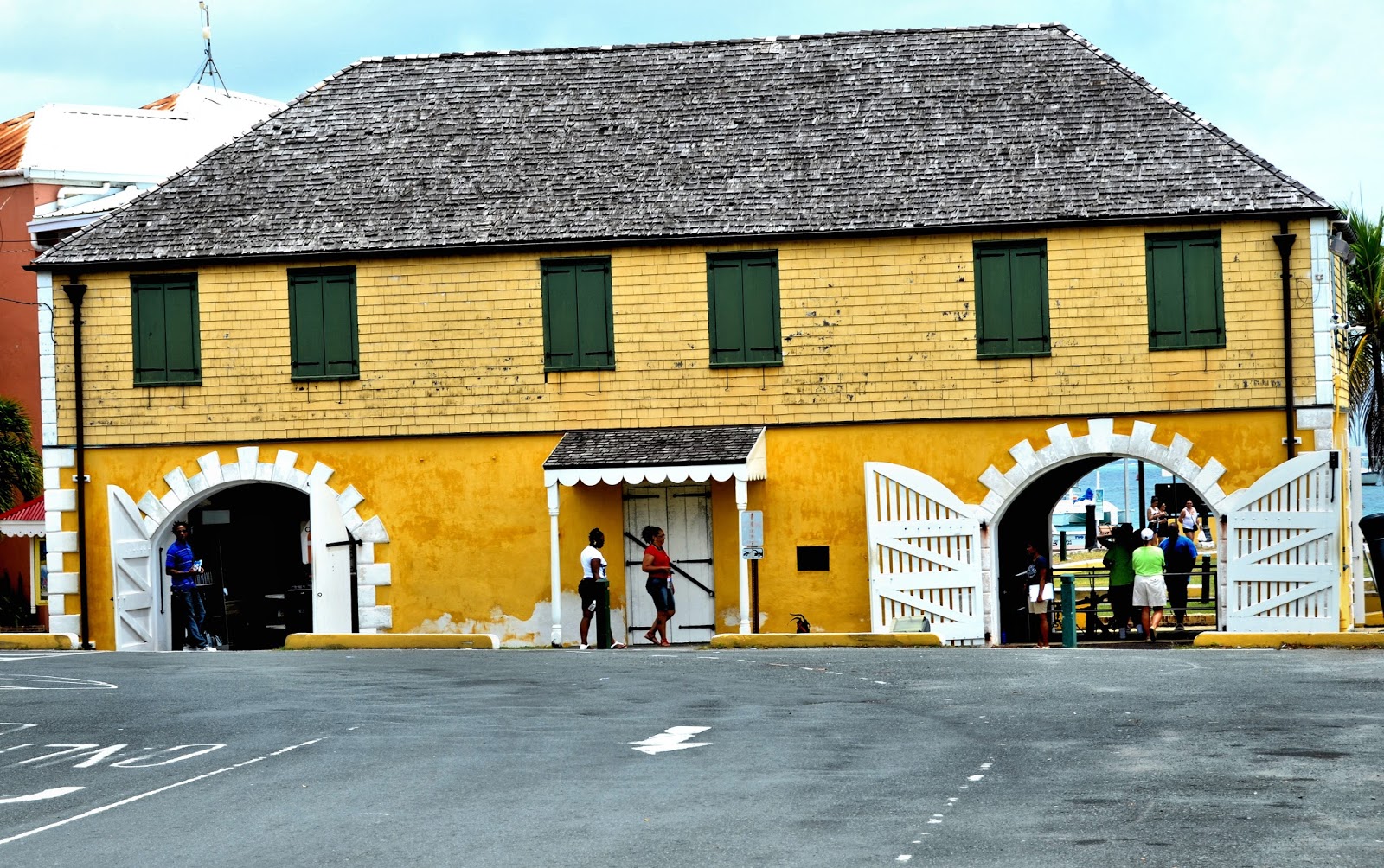
The Scale House built in 1856 replacing the wooden one built in 1840
The shape of the ocean floor just off of Salt River Bay

     In the same area is the "Scale House" where all of the goods that were brought on to the island.  All items would be weighed before exportation of goods like sugar and rum.


Salt River Bay Entrance
    It is back on the Safari again and off to Salt River Bay.  This is another of the National Historic Sites that the National Park Service maintains.  The significance of this bay is that Christopher Columbus and local Indian tribe encountered each other just off shore.  Both sides had one loss of life each.  As a result of the dangerous coast with its shoals and reefs, Columbus' group lost the "Santa Maria, their largest ship.  In all, Columbus made 9 voyages to the area and was very much a part of the colonization  of the area.
Fermentation Tanks Bubbling out soon to be rum

The Rum full drinkable and very good as well
     Our Final stop on the tour was at the Cruzan Rum Distillery with a tour of the facilities.  We were taken through the area where the molasses is prepared and the yeast added before being placed into the very large fermentation tanks.  At the end of 8 hours the fermentation is complete and there is approximately 15% of the volume being alcohol.  It is taken to the stills next where the distillation process leaves the out put at 93% alcohol.  This reduces the rum to being a "neutral spirit".  

     The final out put of the stills is then filtered and put into use whiskey oak barrels for finishing.  The remain in the barrels from 4 to 12 years depending on which expression is being made from that barrel.  We got to visit the aging warehouse and see some of the barrels being emptied for final filtering and bottling.  We got the opportunity to taste the rum as it came out of the barrel as well.  Across the way barrels were being fill and sent back into the warehouse to begin the process again.

Pyrat XO at Christiansted
     It was a very interesting day here getting to know a bit more about St. Croix and Cruzan Rum as well.  This has to be the most historic of the Virgin Islands and a really beautiful place as well.  Each stop we got to taste a nice rum before moving on to the next stop, making the trip even more fun.  This is a Rum Festival after all.
Botran 18 Year Old Solera at Sal River Bay
Mount Gay XO at Millennium


Friday, May 27, 2016

Lookout St. Croix, Bahama Bob is Here

Fort Frederik Opened in 1760 and the site of the Rum Festival
     Today is the start of the St. Croix Rum Festival for me.  We will be judging rums, cocktails and I'm told even a Bikini contest.   What a deal, looks like a very busy schedule and I can hardly wait to get things started.

My Room
     I arrived at three in the afternoon and I was taken immediately to my room at Fort Frederik on the West end of St. Croix.  This is a fort built by the Dutch in the 1750's and opened in 1760 to protect the settlers from the pirates.  I was really scared, but they told me they were just kidding and later took me to The Palms, a great resort in the Christianstad area.
     If you are anywhere in the area, stop on by and enjoy the festive weekend of rum, food and fum at Fort Frederik in Frederiksted, St. Croix on Sunday and at the Palms on Saturday evening.   There more things happening that I can begin to tell you about so make sure you get there to experience them for yourself.

View from My Room at The Palms
     As usual I'll be keeping everyone filled in on all of the action every day on the blog and some other exciting things that happen during the week.   I know that I will have some time to explore the island and maybe get to stop by a distillery or two, time permitting.  Looking forward to getting into gear and enjoying this huge first annual festival.

Thursday, May 26, 2016

New Six-Pack Rings That Feed Marine Wildlife

     I'm not a beer drinker personally, but I have a real problem with our oceans being littered with
plastic of any kind.   The damage it does to the marine life is one of the most serious problems that we have to deal with.  The healthy ecology of the ocean is so important to all of us, and I have to put a shout out to the Saltwater Brewery for caring enough to do something about the plastic six-pack ring.

     The project is the brainchild of the ad agency We Believers, which enlisted a team of engineers to create the rings and approached South Florida-based Saltwater Brewery about a partnership a couple of months ago. The conservation-conscious brewery, which is located in Delray Beach and works with charitable organizations including the Surfrider Foundation and Coastal Conservation Association, immediately jumped at the opportunity to combine its two passions, brewery President Chris Gove told Mashable.

     "We believed in it so much," Gove said. "It came about through a love for the ocean and truly caring for the environment."


      Created with a 3D-printed mold, the rings are made from wheat and barley leftover from the brewing process. Unlike plastic rings, which can entangle or suffocate sea life, the biodegradable rings won't harm animals if they're eaten, and won't harm the environment if they're not.

     With 500 units produced last month, Saltwater Brewery and We Believers said they're planning to bring the biodegradable rings to the mass market by the end of the summer or early fall and by 2017, the team hopes to expand production to other craft breweries around the U.S.   "We want this to be the zero waste, zero carbon footprint solution for the industry," We Believers co-founder Marco Vega said. "Instead of taking two years or getting through the loops of corporate America, let's get them out and take it to the next stage, little by little."

Wednesday, May 25, 2016

Kayaking on the North Side of Bahia Honda Key

     Kayaking just off of the mangroves to the north of Bahia Honda Key there are several areas of very shallow waters that contain oodles of very interesting life.   There is an area of jelly fish and other unusual living plants and animals that you rarely get to see except at low tide and in a kayak or paddle board.

     This week we headed west once we crossed under the Highway 1 bridge and entered into the Gulf of Mexico.  Traversing just off of the mangroves you immediately start seeing unique birds and marine life beginning to appear.  Several nurse sharks, crabs, yellowtail, parrot fish and mutton all swam by.  There are a number of unusual what I refer to as plant/animals, like the sponges that grow in these warm shallow zones.

     We went ashore at one place to find what
looked to be a desolate desert zone, where there were skeletons of trees that had been bleached by the sun and wind.  Even here there was very special and beautiful life moving about.  we saw signs of raccoons and birds that inhabited the zone.  There were butterflies and beautiful dragonflies that would light on the sparse number of flowers there.

  Right between the "desert" and the water we found a group of aloe plants flourishing.  This was a real surprise, as the less that 100 foot distance separated the these zones what a difference in what was found living there.
Aloe Plants

     The bird life through out the key is always interesting and
spectacular.  Looking a little closer, you see species that you don't see on a regular basis. Today we saw the usual Osprey, Tern, and Frigate Birds, but this little brown and golden colored bird caught my attention.  It had a beak that was made for cracking seeds, but nothing that had seen before in the keys.  Always great to run across something new that nature can offer you up as you glide through the habitat.

Tuesday, May 24, 2016

Bahama Bob's Gingerito

     Trying some new ideas of bringing in some different flavors into my cocktails, here is one that you might find to be refreshing for an afternoon soiree.     I love the way that the fresh ginger, sweetener and the lime all play on each other and leave you with a lingering spicy flavor.    


Bahama Bob’s Gingerito
1 ½  Oz.  Ron Cartavio Black Barrel
1 ¾  Oz.  Ron Cartavio Solera
¾  Oz.  Lime Juice
¾  Oz.  JM Sirop
6 slices of Fresh Ginger

 Muddle the three slices of fresh ginger in the bottom of a cocktail shaker until it is turned into a paste.   Add the Ron Cartavio Solera, lime juice, and JM Sirop, fill the shaker with ice and shake until well chilled and double strain through a fine strainer into an ice-filled rocks glass.  Float the Ron Cartavio Black Barrel atop the drink.   And garnish with slices of Ginger

Monday, May 23, 2016

Best Selling and Top Trending Rums for 2016

     Spark up a fat one, Fidel. Once again the best-selling rums in the world’s best bars is the one half owned by the Castro’s.   It’s been a tale of towering global sales for Havana Club ever since the Cubans said hello to their little friend Pernod Ricard.  The latest Havana Club- Bacardi bout was won on points rather than knockout blows. In the end, 5% more bars fell into the Havana Club camp rather than that of Bacardi’s.   Either way, only 20% of bars polled didn’t list either Havana Club or Bacardi among their top- three selling rums.  This year the Daiquiri and Mojito were both in the top 10 best-selling classics and while Bacardi might argue its heritage here, if you want to make an authentic Daiquiri the way they do at La Floridita or a Mojito at La Bodeguita, you’re probably best using a brand that’s legal in Cuba. 
     Diageo, meanwhile, is on a different strategy – Zacapa is for the bars you want to go to, Captain Morgan for bars you don’t.   The group has a few other rums, naturally, but in the bars we polled, Zacapa was their smooth operator, talking its way into podium rum position in a third of the 100.  The hurdle for Zacapa is stepping off the back bar on to the rack.  Only 10% of responders said the Guatemalan rum is their default pouring rum.   Yet Zacapa is the trending rum in nearly 20% of polled bars. The rum aged in the clouds looks to be floating in the right direction.
           Diplomatico from Venezuela is on the ascent too. It is fourth among the best sellers and second in the trending list, where 15% of bars said it was the hot rum brand right now.

The World's 50 Best Bars Annual Report 2016

     First Things First, we should say that the World’s 50 Best Bars Annual Report is the new name for the Brands Report and the Cocktail Report combined.   We figured this body of research could be presented in a singular report every January, denoting a full stop, not a comma, to industry’s year of business.    We’re pleased to say that 28 of The World’s 50 Best Bars took part in this survey. Not a bad return, given there’s no prize at the end – except this invaluable report, of course.   But we didn’t stop there. The top 50 are the inner circle, but our Academy vouched for 542 bars in total last year.   Of these we contacted the top-ranked 250, widening the pool to gain greater global insight and reduce the risk of anomalous results.
    In total we gathered 100 completed

questionnaires, which we feel an accurate representation of the best bars in the world.   You’ll see below a list of all the Top 50 bars that took part and those that have featured in previous lists.   This year we had respondents  from bars from 28 cities in 15 countries and six regions.
     Europe,  as a continent of 50 countries and a powerhouse of the bar industry – made up the largest share, but we have strong representation from North America, Asia and Latin America, and a sprinkling of bars from Australasia and Africa & Middle East.  This distribution is consistent with the geographical mix of bars at the top end of the business, as evidenced by our World’s 50 Best Bars poll. 
     We asked bars’ owners and head bartenders to rank their top three best-selling brands in each category.   In previous years we have only asked for the number one best seller, but in learning the top three, we are able to get a better picture of sales.   The best-selling spirits, liqueurs, champagne, beer or water can be measured in bottles used, which provides the most tangible insight into the consuming habits in elite bars.   But, as we know, a best-selling brand, even in the best bars in the world, earns its place on more than taste.   The best bartenders won’t serve any old hooch but they are also running a business. So we too wanted to know the brands that are not necessarily doing huge volumes but have cool-appeal right now.  So the trending lists – to borrow from Twitter parlance – are made up of brands customers are increasingly asking for. 
     These could be offering innovation, or might have benefited from a clever marketing ploy.   It could be down to word of mouth, or maybe a bartender’s recommendation.   It’s possible that trending brands also feature as best sellers in a given category.   But more likely, they are smaller operators that aren’t the hulking front men of large portfolios and have become on-trend in spite of an inferior inability to incentives.  

We have also collated cross-category top 10s. Bartenders’ Choice is one for the purists as it is untouched by the meddling hand of profitability or the whim of consumer trend.   It’s here we see what bartenders themselves prize most. We also have an overall Best-Selling Brands and overall Top Trending lists, which too pit brands across the spirits spectrum, rather than category by category.   Independent, unsponsored, impartial and compiled using a robust methodology, we feel this is the sort of research that makes the drinks industry a better-informed place. 
Read More at http://www.drinksint.com/news/fullstory.php/aid/5815/Annual_Report:_Rum_Top_10_.html 

Sunday, May 22, 2016

Mother Nature's Gallery

     One of the most beautiful parts of nature come from the sun, the sea and the sky coming together.  Mother nature has provided us with the opportunity nearly every day to enjoy her fabulous art works.  I spend a lot of time on the water these days and I get the opportunity to enjoy a huge gallery of her works.  Hope you enjoy visiting this gallery today.


Saturday, May 21, 2016

Joy Spence Marks a Major Milestones, As Appleton Estate® Jamaica Rum Master Blender Celebrating 35 Years In The Industry


Gruppo Campari Honors Joy Spence

Joy Spence
     May 19, 2016.  Sesto San Giovani, Italy.  In today’s fast-paced world it might be hard to imagine spending five or even ten years at one job.  Gruppo Campari is celebrating loyal employee and spirits industry legend who has been on the job for three and a half decades.  Appleton Estate Jamaica Rum Master Blender Joy Spence was recognized yesterday at the Gruppo Campari Annual Convention for having served the spirits industry for 35 years.

     In commemorating Joy's contribution to the industry, with a career spanning back to the 1980s, Gruppo Campari’s Chief Executive Officer, Bob Kunze-Concewitz, said: “Gruppo Campari is honored to have a legend of the spirits industry in charge of crafting and ensuring the exceptional quality and taste of our Appleton Estate brand. The entire Campari Joy Spence Family joins with rum enthusiasts around the world in congratulating Joy on this significant milestone in her career.” 

     Joy has the distinction of being the first female Master Blender in the Spirits industry, and she will also celebrate her 20th Anniversary as Master Blender in 2017.  Among Joy’s many award-winning creations for Appleton Estate Jamaica Rum are Appleton Estate 50 Year Old Jamaica Rum (the oldest barrel-aged rum in the world), Appleton Estate Reserve Blend, Appleton Estate Rare Blend 12 Year Old, and the Appleton Estate 250th Anniversary Blend, which was her first creation as Master Blender. In addition, Joy is currently preparing a limited edition blend of rums aged at least 25 years which will be released in concert with her 20th anniversary as Master Blender. 


     Joy was awarded the Order of Distinction in the Rank of Officer by the Government of Jamaica for her service to industry. Joy also possesses a honorary Doctorate of Science degree from the University of Loughborough and a honorary Doctorate of Laws degree from the University of the West Indies.

Friday, May 20, 2016

Time is Running Out for the St. Croix Rum Festival


     It is a week from Sunday and you really don't want to miss this one, so get your flights and rooms booked and be ready to party on St. Croix.  Tickets are available on St. Croix at: Global Tours Travel, Hair Plus, Mr. Cheap, Gas For Less, Urban Threadz, Gas City, Neighborhood Pharmacy and The Shoe Bar.   Otherwise you can get them  online @ www.stcroixrumfestival.com  


Thursday, May 19, 2016

18th Century Sailors Killed By Poisoned Rum?

The use of lead equipment in 18th century rum production may have contributed to the deaths of British sailors in the Caribbean think archaeologists.
     Recent examination of skeletons from the Royal Naval Hospital cemetery in Antigua showed extremely high levels of lead in the bones, possibly caused by the high levels of the metal in the sailors’ rum ration.   Anthropologist Tamara Varney said historians have long believed a high death rate among members of the British Royal Navy and at a time when the navy dominated the Caribbean was due to alcoholism and lead poisoning.

     A team from the Lakehead University in Ontario looked at the amount of lead in the bones of 17 adult males.   Concentrations ranged between 13 and 336 parts per million (ppm).    A ‘normal’ amount of lead would be anywhere between five and 30 ppm, while lead poisoning is typically anything over 80 ppm.   The leader of the team, professor Tamara Varney, told the Daily Mail that lead poisoning as a result of high doses in rum rations has previously been suggested as being a serious health issue for the Royal Navy in the 18th century.   However, she told the paper: “This idea had never been tested on the remains of individuals serving in the navy at the time.”
     If the bodies came from the early 19th century then food stored in lead cans would be a likely suspect but the bodies in question date from the time of the French Revolution, just before canning came into widespread use in the Navy.  

     Rum was given to the sailors as part of their daily ration (mixed with water and citrus juice) and in tropical regions like the Caribbean their ration was often augmented to help ward off diseases such as Yellow Fever, which ravaged the European garrisons stationed on the islands at the time.   So serious were the epidemics that being sent to the Caribbean was often tantamount to a death sentence and the islands gained the grisly moniker of ‘the white man’s grave’.
     Many of the bones found there also showed high levels of mercury, which was, likewise, widely used as a medicine at the time as its dangerously high toxicity was not understood.   Soldiers and sailors of the 18th century therefore were, unknowingly, being poisoned with heavy metals from both the cure and supposed preventative to the already lethal ailments surrounding them.


Wednesday, May 18, 2016

A Rum Distillery Near Charlotte?

     Muddy River Distillery in Belmont, North Carolina is just that.  It is the oldest and the only "Legal Rum Distillery" in North Carolina, really making an original and the real thing.  

     At just three years old, Muddy River Distillery is North Carolina’s first and oldest rum distillery since prohibition, staking claim on an as-of-yet untapped craft liquor market in a state that’s currently home to more than 100 craft breweries.   Banking on a trajectory that would follow that of North Carolina’s craft beer boom, founders Robbie and Caroline Delaney appear to have hit a home run with their rum distillery.   The two-person husband and wife duo took Robbie’s  at-home alcohol-making hobby from borderline obsession to full-blown business in less than a year.

     The idea first came to Robbie on a flight to Charlotte to visit Caroline when they were dating. While on the plane he read an article about the growth of craft breweries across the country and throughout the Charlotte area, thought to himself  that “Beer is already here. Why just be one of hundreds of craft breweries, when you can be the first craft rum distillery?”
     Today Muddy River operates out of a sprawling 6,000-square-foot warehouse on the banks of the Catwaba River in Belmont, just to the east of the Charlotte Airport.  Robbie and Caroline are churning out 300 bottles of rum a day, making a real name for themselves.

     Queen Charlotte Reserve is their nicest expression, it has enough flavor and smoothness to be sipped straight or on the rocks.   You generally don't find a sipping rum produced by a distillery that has only been around for a little over four years, but you will change your mind once you taste Queen Charlotte’s Reserve.


Tuesday, May 17, 2016

Bahama Bob's Ginger Tea

Looking for a cocktail that has the flavor of a fine agricole rhum and the zing of spices and lime?  This is a take off on a T-Punch, but it really comes to life in your glass.  This is another really nice cocktail for a sunny afternoon on the lanai or the aft deck.

Bahama Bob's Ginger Tea

  • 1 ½ oz. Damoiseau XO
  • 1 oz. Ginger Liqueur
  • Juice of ½ Lime
  • ¼ oz. Sugarcane Syrup
  • Splash of Barritt’s Ginger Beer
        Place all ingredients except the Ginger Beer in a shaker filled with ice  and shake until chilled.  Strain into a tumbler filled with fresh ice and top up with Barritt's Ginger Beer.  Garnish with a lime and a sprig of mint.

Monday, May 16, 2016

A Taste of Pusser's Spiced Rum

     There is a new Red Pusser’s Rum Bottle out there, It is Pusser’s Spiced Rum.  In the glass the rum is a lovely amber color. The nose is predominantly ginger and cinnamon with notes of oranges with hints of black pepper and caramel.  Despite being only 35% ABV it still provides a good mouth feel like a real rum.

     Pusser’s Spiced has a little surprise in that the Spices are more subtle and much smoother.  The Spiced is very easy to sip and bold enough to stand up to mixing without getting completely lost in the mix.  There is no noticeable notes of vanilla in the spice blend, but rather a rather spicy and zesty flavor.   Notes of ginger, orange and hints of cinnamon and pepper add to the heat of the finish. The finish is flavorful and lingers offering a nice smooth and easy fade.

Sunday, May 15, 2016

Grenada's Westerhall Distillery Grounds

     The once massive Westerhall Estate is still a beautiful place to walk through time to immerse yourself in the days of rum making the traditional way of the 1700’s.  You can see many of the remaining pieces of the original equipment that churned out the rum. Located on the southern side of Grenada in St. David, it is a bit out of the way, but a trip well worth making to get a sense of the history of rum making on Grenada.


Saturday, May 14, 2016

HISTORY OF THE DAIQUIRI by Cocktails 101


     This is a well researched piece on the background and evolution of the daiquiri over the year.  This is a cocktail that I find to be one of the most versatile anywhere and a favorite for its flavor and simplicity.

     Ernest Hemingway put away 15 frozen daiquiris in one sitting, while John F. Kennedy sipped daiqs when he beat Nixon in the 1960 presidential election—at least according to legend. Today, daiquiris are the beloved beverage of cocktail aficionados and wannabe vacationers to the newly reopened Cuba. Below, every single thing you need to know about one of the most classic of classic cocktails—history, tips and techniques, recipes, and variations.

     While most vintage drinks lack documentation proving their precise point of creation, the daiquiri's origin is backed up by an actual cocktail recipe card signed by a "Jennings Cox" in 1896.
Cox, an American engineer who lived and worked in Cuba after the Spanish-American War, is believed to have invented the daiquiri after running out of gin while throwing a cocktail party. Since rum is plentiful in the country, it proved a convenient substitute in a punch he was serving. Unlike what's stated on his recipe card, the drink was made with limes—since lemons were unheard of in Cuba—and brown sugar. It turned out to be a huge hit, and Cox christened it the "Daiquiri," naming the drink after a nearby port town, which also happened to be where the U.S. first invaded Cuba during the Spanish-American War.

     However, considering the island has a bounty of lime, sugar, and rum, it's likely that Cox was merely the first to pen the recipe of a cocktail that had already existed in Cuba. Not to mention that a prototype of the daiquiri—"grog" with lime juice, sugar, rum, and water—had been saving the British Royal Navy from scurvy for centuries before. And variations of rum-lime-sugar drinks previously populated Cuba (el draque, the precursor to the mojito, was invented by Sir Francis Drake during the 1500s) and the Caribbean (ti' punch from 1887).

     But, in 1909, Cox's cocktail, which until then could only be found in Cuba, was brought to America by Admiral Lucius W. Johnson. The U.S. naval officer, who had visited Cox and fell in love with his daiquiri, introduced it to Washington, D.C.'s Army and Navy Club.
Then, four years later, bartender Emilio "El Maragato" Gonzalez of Havana's Hotel Plaza started serving the daiquiri up, shaken and strained into a coupe glass, as opposed to shaken and poured into an ice-filled flute. He also swapped in white sugar for brown sugar. This new presentation, along with the sweetener switch, allowed the rum to shine. Plus, it wasn't as diluted.
Between the 1920s and 1930s in Cuba, the daiquiri underwent an important transformation. Constantino "Constante" Ribalaigua Vert, bartender and owner of a little bar in Havana called El Floridita, perfected the drink with just shaved ice and the whir of an electric blender. And the frozen daiquiri was born.
Soon after, Ernest Hemingway, who was living in Cuba, happened into the bar and, after sampling Constante's frozen creation, requested it sans sugar and with double the rum on account of his diabetes. This, of course, made the cocktail conducive to epic drinking sessions and motivated Hemingway to become a bar regular. In one account from Berry's book, Hemingway put away 15 double frozen daiquiris in one sitting. This earned the cocktail a permanent spot on Floridita's menu as the "E. Hemmingway [sic] Special."

Papa Hemingway's super tart recipe eventually evolved to the more drinkable Hemingway Daiquiri, a classic that now includes grapefruit juice and maraschino liqueur, in addition to rum and lime.
Read More at http://www.eater.com/drinks/2016/5/12/11327350/daiquiri-cocktail-recipe-rum-lime-cuban-drink 

Friday, May 13, 2016

Gruppo Campari Tests New Spiced Rum Brand, Baron Samedi

     Gruppo Campari is testing a new spiced rum as it looks to extend its presence in the category.   Speaking to analysts following the release of the company's first-quarter results yesterday, CEO Bob Kunze-Concewitz said the move was a "major new innovation" for the company. The new product is called Baron Samedi - named after a Haitian voodoo god.   "The spiced rum world is awash with sailors, pirates, admirals and such," Kunze-Concewitz said. 

Baron Samedi James Bond Movie
  "We're coming with, I think, a very distinctive proposition built on the voodoo storytelling available in the Caribbean.   So, let's see how that goes." Kunze-Concewitz did not disclose test markets on the call but the Baron Samedi website's age gate gives Australia, Canada, US and Mexico as country options.  


     The Baron Samedi features Caribbean column still rum and a small amount of Jamaican pot still rum.   It is made up of 100% natural ingredients including vanilla,  cocoa, cinnamon and our signature spice, Haitian Vetiver - a bunch grass that adds earthy and woody notes.

      On the palate, it is smooth and rich.  Baron Samedi is specifically blended to be paired with traditional spiced rum mixers such as cola or ginger beer, or to be enjoyed as a shot.  Served up at 45% abv this is not your mamby-pamby spiced rum.  It truly packs a punch.  Suggested Retail price is around $29.00.

Thursday, May 12, 2016

You Can Buy Your Own Spirits Still, You Just Can't Use It

     Here's the good news. You can own a spirits still. There's no law against that. There's even a company, Clawhammer, that will sell you a beautiful copper still that's designed specifically for producing booze. The bad news? You can't actually make booze in that still. "It's legal to own a still of any size," says Kyle Brown, founder of Clawhammer. "You can have it for decoration, distilling water, distilling essential oils. but it's illegal to distill alcohol without having either a distilled spirits permit or a federal fuel alcohol permit."


     A Federal Fuel Alcohol Permit, which is free and easy to get. "We've never heard of anyone being denied this permit and have never heard of anyone even being checked up on after obtaining the permit," Brown says. The ingredients, the process, and even the final product is the same when making high proof distilled spirits and fuel alcohol. "With this permit, you can make distilled spirits," Brown says, "but the product is supposed to be used for fuel alcohol purposes only."   Legally, you're not supposed to drink it. You're supposed to put it in your lawnmower.


     The real question is what is being done about this?  There is an outfit called the "Hobby Distillation Association" that is working toward legalization for the hobby distiller. 

  LEGALIZATION PROGRESS

    The Hobby Distiller's Association is working towards the legalization of hobby distilling.   Unless you live in New Zealand it is most likely illegal for you to distill alcohol at home, even if it is purely as a hobby. This is in contrast to making beer or wine, which is legal in most countries without permits, licenses, or payment of tax. It is time for change!   The hobby distiller is not a backwoods moonshiner distilling for profit.    He often uses sophisticated equipment, distilling mainly for enjoyment, and often as the next step in the legal hobby of wine or beer making. 
     In the United States, distilling alcohol without proper permits is illegal.   And although there are permits for distilling alcohol for use as a fuel, there's no such license for distilling small amounts of beverage alcohol.   That leaves the hobbyist with two options- distill as a hobby illegally, or don't distill. The HDA (Hobby Distillation Association) is pressing to change to this by forming the first single, unified, consistent, and strong voice for the hobbyist.   “We absolutely do not support ‘moonshining’ activities where individuals sell their shine for profit.”.

     It is going to be interesting to watch if this idea of making small quantities of drinking spirits for personal consumption will ever happen here in America.   Right now you can get into serious trouble if you get caught today.


Troy Roberts of Drum Circle Displaying his 1 Gallon Research Still at the Miami Rum Festival