Friday, August 10, 2018

Wray & Nephew Rum Sales Surpass $6 Billion at Half-Year


     Sales of the Jamaica rum brands owned by Campari Group rose above $6.1 billion over six months ending June.  Through J. Wray & Nephew Limited, JWN, Campari holds the largest stake in the local market and as such, the performance of its brands, led by Appleton and Wray & Nephew, gives a measure of the activity in the overall rum sector.   Campari said Jamaica's sales increased 14.8 per cent in the first half of the year "thanks to the double-digit growth recorded in the period by all the main brands, such as Campari, Wray & Nephew Overproof, Appleton Estate and other rums and local brands, especially Magnum Tonic".


     Globally, the Jamaica rums portfolio represented 5.1 per cent of total sales for Campari group. Sales from the local rum portfolio are up globally, but sales of the group are down some 4.4 per cent to €778.2 million as at June 2018. Despite the dip in sales, group net profit before tax increased to €166 million, up from €108.5 million a year earlier.

     "Wray & Nephew Overproof recorded a good result in the first half, thanks to healthy performances in Jamaica, the brand's core market, the US and the UK," the spirits company said.  Within the Americas, Jamaica's double-digit growth was only bettered in Mexico, where sales rose 16.1 per cent.   "The Americas region closed the first half with organic growth of 4.6 per cent driven by good performances by the US, up 5.9 per cent; Jamaica, up 14.8 per cent; Mexico, 16.1 per cent and other markets in the Americas region, which made up for the decline in Brazil and Argentina," said Campari.
Read more at http://jamaica-gleaner.com/

Thursday, August 9, 2018

Captain Morgan Apple Smash Has Arrived in the United States


     The expression is described as a blend of Caribbean rum with a green-apple flavor. The new variant joins the brand’s existing range of shot-inspired spirits, which includes, Watermelon Smash, coconut-flavored LoconutCannon Blast and Jack-O-Blast.    Bottled at 30% abv, Captain Morgan Apple Smash is recommended served as a chilled shot, mixed with cinnamon whiskey or in a cocktail with ginger ale.    Captain Morgan Apple Smash is available in the United States for an RRP of $15.99 for a 750 ml bottle.


Wednesday, August 8, 2018

Today is National Rum Day in the United Kingdom

     Today is National Rum Day for those that live in the United Kingdom, we have to wait until Thursday August 16, 2018.  That doesn't mean that we can celebrate both of these days with a great rum or rum cocktail.  Here is one for today and I'll have another one for the sixteenth.

     Here is an idea for today,  Pilar Rum combined with a bit of lime and thyme syrup for a refreshing afternoon cool cocktail.


Bahama Bob’s Rum Thyme

  • 2 oz.  Pilar Dark Rum
  • Juice of ½ Lime
  • 1 oz Bahama Bob’s Thyme Simple Syrup

Place in a shaker filled with ice and shake until chilled and pour into a rocks glass filled with fresh ice.  Garnish with a sprig of thyme or a lemon wheel.


Bahama Bob’s Thyme Simple Syrup
  • 1 cup Sugar in the Raw
  • 1 cup water
  • 2 Tbsp.  McCormick’s Ground Thyme
Bring the water to a boil and stir in the sugar and the thyme. reduce heat and simmer for 5 to 10 minutes.  Allow to cool and place in a refrigerator safe container.

Tuesday, August 7, 2018

Why a Pot Still and Why Add Thumpers, Perforated Plates or Bubble Plates?

Classic Pot Still


     What is the difference in stills and what is happening within them that makes one more efficient or better than the other?  Standard pot stills will give you the most flavor, if your only pass the wash through them once.  If you refine the output from the first pass you will get a product with more alcohol by volume (abv) but less flavor.  If you do it again, the same happens each time you refine the output.


Add-on Column
     If you add a column, with perforated plates or bubble plates to the top abv.  Because you are making fewer passes you will tend to loose less of the inherent flavor of the rum because you ware making fewer runs.   How does this happen?  The plates are like adding another distilling run to your run.  The plates are heated by the rising vapor from the pot, when it gets hot enough to boil the refluxing liquid falling from the plate above, the vapor rises to the next plate accomplishing the same effect.  This continues until all of the plates get hot enough for the vapor to make the top of the column and into the condenser.  Each of the plates effectively re-distills the rum producing a higher abv, and losing some of the flavor each step of the way.
of the your still, you will end up with a pot still that is more efficient.  In general you will have to make fewer passes through the still to get the higher

Thumper Working
     The thump keg or thumper is easier to understand how it works, because is is visually another still.  The hot vapor is bubbled through a liquid in the thumper and first condenses the vapor until it reaches a boiling temperature and the liquid turns to vapor again.  This is clearly another distillation.  The vapor coming off of the second boil will emit more ethanol than water giving you a higher abv,  A second or even third thumper can be added to raise the abv even further.  The thumper can be made to clean the output bu putting water in each of the thumpers , or add flavor by adding tails and heads from previous runs.  This is the way that they get the unique flavors from the Caribbean rums.  What you put in the thumper, gives you the flavor of your rum.

Bubbler Working
     Bubble plates used instead of perforated plates are a more efficient plate that works more like a thumper.  The vapors coming through the plate and being turned back on the plate heat the  plate and the reflux from the plate above, but the vapor bubbling through the cap heats the liquid directly like a thump keg does.  The process continues up the column until it can escape to the condenser. Each plate like the perforated plate are another distillation, but the bubble plate will tend to retain more flavor than a perforated plate,  The only thing you can do is change the flavor by changing the liquid.  It happens automatically.

    I hope this helps you understand a little better what all of the add-ons do for the basic pot still.

Monday, August 6, 2018

Spanish Police Bust Fake Rum Ring


     Spanish law enforcement agency the Guardia Civil has seized over 21,000 bottles of fake rum worth over €316,000 in a series of raids across the country.  As reported by Euro Weekly, the raids took place in Valencia, Cadiz, Madrid, Castellon, Merida, Sevilla, Cordoba and Huelva, resulting in 21,000 bottles of the fake rum being seized.  It was the culmination of an operation that began in Chiclana de la Frontera (Cadiz), where police noticed a flood of rum sold as a prestigious brand to a wholesaler but at rock bottom prices. The Guardia Civil has made 14 arrests on charges of crimes against intellectual property.
     The police were first alerted to the rum ring in Chiclana de la Frontera in Cadiz, where they noticed a prestigious rum brand being sold on an industrial scale to a wholesaler at rock bottom prices. The wholesaler then sold it on to unsuspecting bars and restaurants at a discount.  The counterfeit rum came from Valencia and Castellon, where the Guardia Civil seized a large number of bottles and fake documentation.  Screen companies both in Spain and abroad were used in what was a sophisticated scam. As well as selling the counterfeit drink, the main importer also evaded paying IVA when importing the rum.  Euro Weekly reports that screen companies both in Spain and abroad were used in the sophisticated scam in which the main importer also evaded paying IVA.  


Sunday, August 5, 2018

The Green Heron: The Patient Little Fisherman

     One of the regular visitors to the dock year round is the Green Heron.  It is one of those birds that you don't really notice, but is always around.  It is a accurate fisherman that will sit patiently on dock lines that hang near the water and wait for a school of fish to swim under the line and will reach out quickly and accurately to grab its dinner.

     Their colors blend into their environment very well, so you don't notice them and the fish don't seem to either.  Their neck can stretch over a foot so they can spear their prey and enjoy a good dinner on a very regular basis.


Saturday, August 4, 2018

Jamaica’s Secret Spirit


     Driving west from Kingston towards the Appleton Estate in the parish of St. Elizabeth, on the island of Jamaica, I come upon a fire by the side of the road, pouring thick black smoke into the air. Curious, I stop the car and walk over to where a small crowd has gathered. What is burning, I learn, is a dead cow. It was in such an advanced state of decomposition when discovered, it seems, that the local trash removers wouldn't touch it. The only solution was to set the carcass on fire. I get back into the car, roll up the windows, and plow through the smoke.

     Surprises are common in Jamaica, and you never quite know what to expect—except that it will most likely be something unexpected.
With their often fiery foods, its highly charged reggae, and its bold, proud populace, Jamaica is a brazen and unsubtle place. It seems only natural, then, that rum, the country's most famous indigenous alcohol, should be assertive and uncompromising too. On previous trips to the island, I'd learned something about other aspects of Jamaican life; finally, I went back for the rum.
Rum, which is distilled from either fermented sugarcane juice or molasses (the intensely flavored syrup that is a by-product of sugarcane refining), is manufactured on almost every Caribbean island where sugarcane is grown. Sugarcane—a tall grass (Saccharum officinarum) probably native to India—was first brought to the Caribbean from the Canary Islands by Columbus.  By the 17th century, sugar production had become the dominant industry in the Caribbean. The demand for sugar in Europe was virtually insatiable for a sweet crop.  Today, the Caribbean is far more renowned for its rum than for its sugar, and rum is a source of fierce national pride. There are many outstanding rums in the region, but Jamaican Rums stand alone.  Traditionally full-bodied, they have an unusual, earthy flavor and an almost soothing, hypnotic effect, immediately evocative of the island itself.
 
     The six rum distilleries operating in Jamaica, two are owned by Wray & Nephew, a Division of the Campari Group and the island's principal producer of rum. The other distilleries sell most of their rum in bulk, for blending and bottling by other companies. Campari Group bottles its own, under the Appleton Estate label and several others; its rums account for about 95 percent of that consumed on the island and are exported to more than 60 countries.  In operation since 1749, the Appleton Estate is the oldest rum-producing facility in the English-speaking Caribbean. Covering 12,000 acres and turning out as much as 10 million liters a year, it is also the largest.

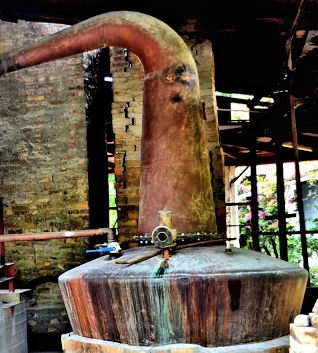
        "We're in a valley, on the banks of the Black River," he says, "and we use the river water to make our rum."    Jamaican rum is made exclusively from molasses, diluted into what is called a wash and then transferred to fermentation tanks. Yeast, taken from the blossoms of the sugarcane, is added to activate fermentation. The fermented wash is distilled in either pot or column stills.  Appleton's ancient-looking pot stills, some of which have been in service since 1749, are shaped like large kettles with long, angled spouts; the sleek, modern column stills are tall, stainless-steel tanks. Both are used regularly, to produce rums with different characteristics.   After distillation, the rum is stored for aging in charred casks of American and Canadian oak, in a large warehouse. Most Jamaican rum is aged for at least three years.   

     Rum has borne its share of epithets over the years. It has been known as "demon rum" and "kill-devil." One critic, back in 1651, described it as "a hot, hellish and terrible liquor".   Rum is a friendly companion, there are eight categories of rum in Jamaica, classified according to the amount of esters that they contain.   Esters are what give rum most of its flavor and fragrance.

     The best-selling rum in Jamaica by far, however, is Wray & Nephew's so-called white overproof, a middle-ester rum at a strength of 126 proof. It's popular partly because it's a good mixer. Some Jamaicans however like it because they have the idea that dark rum might not be good for them, that white rum is somehow purer. And tradition imputes to white rum an almost elixir-like power. Taken with honey and lime, for instance, it is believed to cure colds. It is used to christen newborns and to purify the dead.   It is even said that if you are building a house and sprinkle white rum around the foundations, it will keep the duppies, or evil spirits, away. But if you drink too much overproof, of course, instead of ridding yourself of the duppies, you just might end up having a conversation with them.

Friday, August 3, 2018

The Dunder and Jamaican Style Rums


     Making liquor illegally at home isn't easy. Making rum at home in the old Jamaican style of pot stills, fermenting pits and malodorous but essential dunder is even more challenging.   Dissatisfaction with commercial products. A curiosity for chemistry. Desire for creative license. These might sound like reasonable explanations for an aspiring pizzaiolo to plunk down for a wood-fired oven in the backyard. But what about a spirits still? After all, moonshining has been outlawed or severely restricted by practically every country on the planet, except by those level-headed Kiwis. Yet, the threat of a felony conviction and fine, or worse, a jail stint hasn’t deterred a defiant global underground community of pseudonyms from sharing recipes and advice on recreating their favorite spirits. That includes an especially hardcore subset chasing Jamaica’s traditional aromatic pot-still rums, a style that employs a stinky, yeast and bacteria-laden liquid called dunder for achieving its trademark tropical perfumes.

     Analogous to backset in bourbon production, dunder is the non-alcoholic by-product of a sugar-alcohol distillation left at the bottom of the still. Adding dunder to the next fermentation boosts the formation of aromatic compounds called esters; the higher the ester count, the more pungent the fruity pineapple and banana, even nail polish flavors in the rum. While the definition sounds innocuous enough, in practice, the liquid must be stored between distillations, and that’s when things get funky for the home enthusiast.
     In Jamaica’s headier heydays, when nearly 150 sugar cane estates sported mills and stills (and slavery), 19th-century rum makers dug holes to house the residue. Lore has it goat heads and dead bats, along with rotting fruit, were tossed into the malodorous stew to propagate bacteria that would later alchemize into a boozy elixir. Contemporary commercial producers claim to eschew the “dunder pit” tradition in favor of tanks. Either way, illicit home distillers bent on making a punchy, full-flavored spirit, can’t exactly excavate and openly tend a cesspool along their neighbor’s fence.
     Moonshiner turned commercial still manufacturer, Amsterdam-based Edwin van Eijk said that, given that dunder is an essential building block for Jamaican-style flavor, the benefits of working with it outweigh the drawbacks.   Van Eijk first started experimenting with liquor recipes at his holiday house in Hungary, a country in which government tolerates such recreations and practically every family passes down, házipálinka, homemade brandy recipe to the next generation. Finding most marketplace rums too light, van Eijk searched for ways to create his own. “What my dunder adds to the taste is depth, complexity and intensity,” he said.   
     Fortunately, my job at Hemingway Rum Company, allows me to do some experimenting with dunder and other things necessary to make a good medium bodied rum.  We are a very young operation, but it is a chance to learn about some of these time-honored rum making techniques.  I hope with time, and a stronger demand for the bold Jamaican style rums will once again be available at our local liquor stores.

Thursday, August 2, 2018

Firefly Bicycles Maker Turned Scrap Tubing into Reusable Straws and Sold Out in Hours


     Firefly Bicycles, a manufacturer in the USA has become an unlikely beneficiary of the drinks industry’s anti-plastic movement after it decided to sell straws made from leftover tubing.  One particularly hot day as we were churning through iced drinks to stay cool, we decided to turn scrap tubing into titanium drinking straws. No you can buy them! Custom lengths, colors, and bends,

     Titanium Straws are SOLD OUT! The response has been overwhelming! We have used up 7.5 years worth of titanium scrap in less than 24 hours! As we generate more scrap that can be turned into more straws we will make these available again and broadcast their availability. STAY TUNED! And thanks for your support!!

     The benefits of these straws are threefold.  You can avoid the use of plastic straws and stop contributing to the over 500 million (per day) of ONE TIME USE plastic straws that end up in landfills.  These straws are a by-product of our internal cable routing option and re bound for the scrapper. With a little elbow grease we turn this scrap into something useful that lives on to make the world a better place.  Finally, they are just plain cool as can be
     The 10" size is best for 22 oz. glasses.  The 8" size is best for a classic 16 oz. pint glass.  The 5" size is best for tumbers and we recommend that those be purchased without a bend. They are classier that way.  These titanium straws are MADE TO ORDER, just like our bikes. You can pick the length, the color and whether you want it bent or straight.
     Once again: These are MADE TO ORDER! We do not stock finished straws. We squeeze them into our production schedule when we have a free moment between bike builds so be patient. Generally we are predicting that they will ship in 2 or so weeks.  You can order them at https://fireflybicycles.com/store#!/Titanium-Drinking-Straw/p/111910296/category=3031075     International orders: Please contact us directly as our shipping calculator charges too much for shipping these items.

Wednesday, August 1, 2018

Yesterday We Celebrated the 48th Anniversary of Black Tot Day

     Yesterday marks the 48th anniversary of Black Tot Day.  On July 31, 1970, the Royal British Navy removed the rum from their ships.   Black Tot Day is the name given to the last day on which the Royal Navy issued sailors with a daily rum ration, the daily tot if you will. In the 17th century, the daily drink ration for English sailors was a gallon of beer, but because the beer would spoil at sea, they switched to rum.  This was the end of a tradition that lasted more than 300 years.   There are so many stories about the rum and the sailors that could be told, but in fact it was just a sad day in British Naval history.

     Lets just raise our Glasses to the end of a very special tradition.  This tradition began in 1655 just after the invasion of Jamaica.  By 1740 Admiral Vernon mandated that the rum be mixed with water to cut it town from its 109 proof.  This mixture became known ass grog.  Around 1823 the ration was cut in half, and cut by half again in 1850.  Finally on July 31, 1970 the rations were eliminated completely.  Like I said, a Black Tot Day in British Naval History. 

Tuesday, July 31, 2018

E&J Gallo to Distribute Diplomático in the United States


     E. & J. Gallo Winery announced today that it will be the exclusive U.S. importer for luxury rum brand Diplomático, a super-premium rum recognized and awarded around the world for its superior taste, quality, and mixability, and garnering numerous 90-plus point scores.   The deal will see E&J Gallo import three collections: The Tradition Range $26.99 to $42.99, which includes Reserva Exclusiva; the Distillery Collection $79.99; and the Prestige Range $129.99 to $269.99. Terms of the agreement were not disclosed.   Produced by Destilerías Unidas SA, the Diplomático Distillery, which sits at the foot of the Andes Mountains, has been producing rum since 1959.
     “Diplomático has built an incredible following among the leading mixologists and thought-leading bars and restaurants, and we look forward to continuing that direction as more and more Americans are introduced to luxury rum.”
 
   José Rafael Ballesteros Meléndez, Diplomático Rum’s president, said: “As a family business, we are honored to partner with the Gallo family. We appreciate their long-term view to building brands, and their commitment to continue growing Diplomático’s popularity in the US.”  “We are excited to become the US partner for Diplomático, and look forward to adding their ultra-premium rums to our growing luxury spirits portfolio,” said Bill Roberts, vice president and general manager for Gallo Spirits.

Monday, July 30, 2018

Tales of the Cocktail Foundation Announces 12th Annual Spirited Awards® Winners


     Held during Tales of the Cocktail 2018, the Spirited Awards honors the world's top bars, bartenders, writers and cocktail experts.   Following an impressive pool of nominees and months of deliberation from a global panel of renowned judges in the spirits and cocktail industries, Tales of the Cocktail Foundation is honored to announce the winners of the 12th Annual Spirited Awards®.

      The 2018 class of winners has been recognized amongst peers and supporters tonight at the awards ceremony hosted at the Orpheum Theater in New Orleans during Tales of the Cocktail. In addition to the winners selected by judges, Tales also has awarded the Helen David Lifetime Achievement Award to John Lermayer.

     "As someone who has been on the other side of the Spirited Awards and has been nominated over the course of many years, I know how significant it is for an owner, operator, bartender or spirits professional to be recognized by his or her peers," said Neal Bodenheimer, Co-Chair of Tales of the Cocktail Foundation. "Congratulations to this year's winners who represent a global group of talent setting the bar incredibly high for our industry."

     The sponsors of the 12th Annual Spirited Awards® are The House of Angostura, Bacardi US, BarSmarts, Cocktail Kingdom, Fairmont Hotels & Resorts, Pierre Ferrand Cognac, William Grant & Sons, Gra'it Grappa, Italicus, Japan Sake and Shochu Makers Association, Mandarine Napoleon, Maverick Drinks, G.H. Mumm, Peroni, Pernod Ricard USA, Rutte, VinePair and Woodford Reserve.

2018 Spirited Award® Recipients

American Categories
Best American Bar Team: Presented by William Grant & Sons, Sweet Liberty Drinks & Supply Co., Miami, FL
American Bartender of the Year :Presented by Bacardi USA, Yael Vengroff, The Spare Room, Los Angeles, CA
Best American Brand Ambassador: Presented by VinePair, Anne Louise Marquis, Campari America
Best American Cocktail Bar: Presented by Pernod Ricard USA, Lost Lake, Chicago, IL
Best American High Volume Cocktail Bar: Presented by William Grant & Sons, The NoMad Bar, New York City
Best American Hotel Bar: Presented by Bacardi USA, The Broken Shaker Miami at The Freehand, Miami, FL
Best American Restaurant Bar: Presented by Woodford Reserve, Clyde Common, Portland, OR
Best New American Cocktail Bar: Presented by Pierre Ferrand Cognac, Navy Strength, Seattle, WA

International Categories
Best International Bar Team: Presented by The House of Angostura, The American Bar, The Savoy, London
International Bartender of the Year: Presented by Bacardi USA, Joe Schofield, Tippling Club, Singapore
Best International Brand Ambassador: Presented by G.H. Mumm, Ian Burrell, Global Rum Ambassador
Best International Cocktail Bar: Presented by Pernod Ricard USA, Happiness Forgets, London
Best International High Volume Cocktail Bar: Presented by Rutte, The Clumsies, Athens
Best International Hotel Bar: Presented by Japan Sake and Shochu Makers Associaton, The American Bar, The Savoy, London
Best International Restaurant Bar: Presented by Mandarine Napoléon, Sager & Wilde, London
Best New International Cocktail Bar: Presented by Pierre Ferrand Cognac, Coupette, London

Writing Categories
Best Cocktail & Spirits Publication: Presented by Tales of the Cocktail Foundation, The Daily Beast, Half Full Section
Best Cocktail & Spirits Writer: Presented by Fairmont Hotels & Resorts, M. Carrie Allan, The Washington Post, Imbibe, and more
Best New Cocktail or Bartending Book: Presented by Gra'it Grappa, Meehan's Bartender Manual by Jim Meehan
Best New Book on Drinks Culture, History or Spirits: Presented by Cocktail Kingdom, By the Smoke and the Smell by Thad Vogler
Best Broadcast, Podcast or Online Video Series: Presented by Tales of the Cocktail Foundation, Life Behind Bars

Global Categories
Best Bar Mentor: Presented by BarSmarts, Andy Seymour, Liquid Productions
Best New Spirit or Cocktail Ingredient: Presented by Maverick Drinks, Del Maguey Single Village Mezcal Jabali
World's Best Cocktail Menu: Presented by Peroni, Dandelyan, London
World's Best Spirit Selection: Presented by Tales of the Cocktail Foundation, Sweet Liberty Drinks & Supply Co., Miami, FL
World's Best Bar: Presented by Italicus, The American Bar at The Savoy, London
Helen David Lifetime Achievement Award: Presented by William Grant & Sons, John Lermayer


Sunday, July 29, 2018

Westerhall Distillery on Grenada

     My visit to Grenada a few years back has left  indelible images in my mind.  The very old and basic distilleries that are on the island that go back to the earliest days of rum in the Caribbean.  This water wheel that is sitting on the hill behind the now closed Westerhall Distillery is a great example of the rum history that is so much a part of Grenada.


Saturday, July 28, 2018

Renegade Spirits Has a Groundbreaking New Rum Distillery in Grenada

Renegade Rum Company

      London-based distiller Renegade Spirits has begun work on its groundbreaking new rum distillery in Grenada.  Located near Pearl, on the north-eastern side of the island, the new distillery will cost $20 million, being both technologically advanced and environmentally sound. Designed to produce up to 1 million liters of spirit each year it will be one of the most significant rum distilleries in the Caribbean.
     The Renegade Rum project has already created 50 jobs locally, with a further 100 jobs requiring a wide range of skill levels to be created over the next year, all in a rural area of high unemployment. The aim of the Renegade Rum Distillery is to distill and mature the most compelling rum the world has ever seen.
Still Parts Arrive
     Using the latest techniques and equipment, together with an innovative, industry-challenging philosophy, Renegade Rum believes this is a landmark rum project that will raise the bar worldwide.  Drawing on experience from both the Scotch and Irish whisky industries, as well as the wine world, Renegade Rum is the brainchild of CEO Mark Reynier, who runs Waterford single malt whisky distillery in Ireland, and who was behind the renaissance of the famous Bruichladdich distillery on Islay, Scotland, in 2001.  Reynier said: “This project has been completely back to front: we’ve had to propagate cane first, and only then build a distillery.
     “I had been looking for a home for this project for over a decade before I found Grenada, but after my first trip around the island it was clear there was no cane left, just bush. We would have to start with a blank canvas, to prove there is enough cane potential to make it worthwhile building a distillery.   “And that’s where we are now today. During those three years we have been designing the distillery, taking advantage of the latest ideas from the top engineers in the business, while simultaneously planting cane lands.”
Mark Reynier CEO and Dr. Keith Mitchell Prime Minister
 Break Ground for New Renegade Rum Distillery in Grenada
     Prime minister of Grenada, Dr Keith Mitchell, said, “When I first heard about this project I was not entirely convinced that it could be brought to fruition but standing here today and learning of its many unique facets, I must say it is historic in every sense. The project will not only help boost the agriculture sector and enable diversification of the economy, it will also provide invaluable promotion of Grenada as the origin of this unique blend.   “The location of the project will have a remarkable impact on this rural community, spurring significant development outside of areas usually targeted for business operations. I commend Mark and his team for staying the course, for their determination to forge ahead with the evolution of this concept into a reality and most importantly, for choosing Grenada. This is a project all of Grenada can be truly proud of. I believe its reputation will spread far and wide, along with that of our beloved island.” 
CaneCo Sugar Cane Fields in Grenada
     Renegade Rum Distillery will use exclusively sugar cane reintroduced to Grenada in 2016 during the first phase of the project. The remote greenfield site will be surrounded by cane fields with the mill, utilities and distillery buildings located on three terraces overlooking the Atlantic Ocean to the east, extensive water meadows to the south, and a saltwater mangrove lake to the north.  With the main equipment coming from Scotland, Ireland, Brazil, America, and South Africa, there is a global context. The rum – made by Grenadians with Grenadian cane – once matured and bottled, will go back out across the seas to global markets.
Special Locally Grown Sugarcane
     Renegade Rum Distillery has a close partnership with CaneCo, its agricultural supply company that was set up three years ago to propagate, cultivate and harvest super-premium sugar cane to supply the distillery. Taking a terroir driven approach to rum production, numerous varieties of cane are grown across the island on varying soils and altitudes to maximize flavor differences.  The harvest from each field of cane will be milled and distilled in isolation – from field to barrel. This will allow Renegade Rum Distillery to capture in its distillates the numerous expressions gleaned from Grenada’s unique soils and micro climates. With such attention to detail, it will be able to create a rum of unparalleled complexity. Renegade Rum’s distillate will be matured in oak barrels, before being brought to market around 2021/2022.

Friday, July 27, 2018

Plantation Rum Launches Preservation Initiative

Home of the Ferrand Plantation Foundation
     Plantation Rum has outlined plans for its new center dedicated to the research and preservation of   In 2017, Plantation Rum owner Maison Ferrand purchased an 18th-century estate in France, with plans to transform the site into a permanent home for the Ferrand Plantation Foundation, the brand’s foundation dedicated to the preservation of rum.   This estate will become a location dedicated entirely to rum research and education. It will include vintage documents, books and papers amassed by Maison Ferrand founder Alexandre Gabriel.
rum, as well as unveiling a new limited edition expression.

     Currently undergoing extensive refurbishment by a team of artists, once open, the Ferrand Plantation Foundation will welcome rum aficionados, collectors, scholars and fans.   As well as unveiling details of the foundation, Plantation Rum today announced the release of a new expression created in collaboration with rum collector Steve Remsberg.

     Plantation The Collector Jamaican Rum has been produced using rum made at the Long Pond Distillery in Jamaica.   The expression was created after Remsberg challenged Gabriel to recreate the flavors of a rare bottling in his collection, which had been out of production for several years.   Gabriel said: “I had the great fortune to explore Steve’s extraordinary collection, sharing with him his favorite, the mythical old Jamaica, which he asked me to recreate.   When Steve finally tasted my sample, I was nervously waiting for his comment. This extremely rare edition is my gift to my dear friend Steve.”   Just 999 bottles of The Collector will be released in the US and Europe, and all proceeds from its sale will be donated to the newly established foundation.

     Remsberg, who is known for having one of the largest private collections of premium and rare rum in the world, will be donating his rare rum collection in its entirety to the Ferrand Plantation Foundation.   Within the foundation’s home in France, a room will be dedicated to the collection, offering visitors the chance to watch videos of Remsberg explaining the history of each bottle and how they were acquired.   Remsberg said: “I’m very excited about Alexandre’s plans and dreams for this Foundation.  “My intention in putting together the collection, for the last 25 or so years anyway, has been that somebody in the future could use if for research into rum history or rum heritage. So I’m very, very optimistic. I know that Alexandre is committed to it, to keep it in one piece and what more of a heritage could anybody ask.”


Thursday, July 26, 2018

Bahama Bob's Honey Wind

     Summertime is for minty fun cocktails.  This is the time for a "sweetart" kind of drink that is refreshing and fun.  Give this one a try for your weekend get together on the patio or the boat, you will enjoy it.  I always enjoy the summer cocktail fare.


Bahama Bob's Honey Winds
  • 1 1/2 Doorly’s XO Rum
  • 8 Mint Leaves
  • ½ oz. Bahama Bob’s Honey Syrup 
  • Top with Sparkling Ice Pink Grapefruit
  • 5 dashes Angostura Aromatic Bitters


     Combine Doorly’s XO Rum, mint leaves and honey syrup in a shaker tin with ½ filled with ice and give it a quickly shake to bruise the mint. Pour into a glass tumbler add ice to the top and top up with Sparkling Ice Pink Grapefruit and more ice if needed. Dash the bitters on top, slap the mint sprigs with your hands to bring out the oilsand place in the glass as a garnish.


Bahama Bob’s Honey Syrup


     In a sauce pan, place equal parts of honey and water, bring it to a biol, stirring until the honey is all dissolved. turn down and simmer for about two to three minutes.   Allow to cool and place in a suitable container and keep refrigerated until you use it.


Wednesday, July 25, 2018

The Rum Lab Releases the Launch of The Miami Rum Congress


     The Rum Lab has announced their newest event called the Miami Rum Congress that will take place on February 7th and 8th, 2019. With the intention to continue promoting the education and premiumization of rum; the event will be divided into two parts.   Part one will take place on February 7th and will be straightforward industry symposiums tailored to rum producers, distillers, importers and other supply chain professionals.   The second part of the event will take place on Saturday, February 8th, 2019 tailored for rum aficionados that want to indulge in premium rum tasting and seminars.   The goal with the events is to feature more than 40 premium rum brand expressions from around the world, accommodate members of the beverage trade with intimate access to brand representatives, tastings, seminars and educational breakout sessions.

     Attendees have the opportunity to participate in amazing seminars with world-renown industry guest speakers such as: Richard Seale - Fourth Generation Master Distiller, Foursquare Distillery, Barbados.  Daniele Blondoe - North Americas Director for La Maison & Velier  .  Ian Burrell - Global Rum Ambassador, Celebrity Judge and producer of the UK Rum Fest.  Bailey Pryor - 5 times Emmy Award-winning documentary film producer and CEO of The Real McCoy Rum.

For more information on each event visit www.therumlab.com or www.miamirumcongress.com


Tuesday, July 24, 2018

United States Craft Distillery Operations Rises by 26%


     In 2016 there were 1,315 active distillers in the United States, that has risen to 1,589 in 2017, according to the data compiled by the American Craft Spirits Association (ACSA), Park Street Imports, and the IWSR.   A craft spirits producer is defined by the ACSA as a producer that has not removed from more that 750,000 proof gallons from bond.  It also markets itself as craft; is not openly controlled by a large supplier and has no proven violation of the ACSA Code of Ethics.

     The West boasts the largest number of distilleries, some 32.7 %, but the South with classic spirits states like Texas, North Carolina and Kentucky, comes a close second with 29.3%. The Midwest accounts for 19.1% and the Northeast 18.9%.  California is the state with the most distilleries: a total of 148, which makes up 9.3% of the nation's total. This is followed by New York, Washington, Texas and Colorado.  On average, more than half of a craft spirit producer's US sales come from within its home state (18% at the facility and 34% outside its premises).  "Nearly one-fifth of all sales take place at the production facility, underscoring the importance of tasting rooms and on-site retail to the bottom line,"? says ACSA in its 2017 annual report.


     Working at the Hemingway Rum Distillery in Key West is great to be a part of the growth of the past year.  Here in Key West, we have three craft distilleries, which is a lot for a two by four mile island.   The strength of the craft distillery, especially in a place where there are a large number of tourists is staggering.  The interest in how spirits are made and being to get up close and personal with the fermentation tanks and stills make the experience even more special.  The purchase of a bottle of spirits that the distiller can sign for you give the place a personal feel that you can take back home with you.

     "The legislative action has helped level the playing field for spirits within the broader craft beverage space, putting distillers on par with breweries and wineries. Prior to the law's enactment, a craft spirits producer had paid 5.4 times more FET than a craft brewer and 16.4 times more FET than a small winery, for equal quantities of beverage alcohol.?  "While it certainly is a time to celebrate, our work is only just beginning. ACSA's priority now is to ensure that Congress votes to make the tax relief permanent."?   The American Craft Spirits Association is a registered non-profit trade group representing the U.S. craft spirits industry.

Read More at beveragedaily.com