Wednesday, April 2, 2014

Homeward Bound Today


My lodging on Lake Norman
    It is always nice to get off of the rock once in a while, but I find that no matter where I roam or visit, I ultimately love getting back to Key West.   This little rock provides me with a lot of comfort and inspiration to keep writing, and pressing ahead with new projects and lots of fun.   Though the trip was a business trip, I did find some time in the evenings to get together with a number of old friends.   Always good to see them when ever I get up this way and have the opportunity.


Karaoke with Gary Woods
     Today I board a jet in Charlotte and in just over 2 hours I will
be back on the boat and picking up life where it left off on Sunday evening.   Wednesday is not a real exciting day for most people, but for me it is a chance to get together with a lot of friends at the Hurricane Hole and make some noise.  Yes, it is Karaoke night with my friend Gary Woods spinning the discs.   There is a regular crowd of us crazy people that are brave enough or at least drunk enough to go up and belt out a song or two, but mostly just having a fun evening.  

     My arrival back at Key West at 5:11pm gives me just enough time to get to the boat, toss the luggage aboard, change and be at the Hurricane Hole by six for the start of karaoke.    It is always fun on the road, but the old adage of "there is no place like home " rings so true for me when I get to return to my fun little island.  ;o)

Home Sweet Home and at the Hurricane Hole


Tuesday, April 1, 2014

Taking Care of Business The Story of Raul Vasquez

     Raul Vasquez owned what is now the Speakeasy Inn and Rum Bar during Prohibition.   This is a great story adapted from an article in Martello, a publication of the Key West Art & Historical Society, from 1967­ ten years after Raul Vasquez passed away.
 
 
This is a true tale of one Raul Vasquez, an enterprising resident of Duval Street who needed to provide for his family and knew of a way to get it done.

Prohibition was a sad state of affairs visited upon those United States citizens who occasionally liked to indulge their taste for alcohol. For almost four years, it was illegal to manufacture, import, export or sell the spirit. Government Agents busted distilleries and raided speakeasies in cities around the country. But who was looking at a little island down off the coast of Florida? Only the drinkers (and those who supplied them,) it seemed.

Key West was a wide-open city, and both residents and tourists alike kept suppliers working night and day bringing in boatloads of rum from Havana. There were few legitimate, good paying jobs in 1930's Key West, so in order to make ends meet, Raul Vasquez decided to become an supplier..

He had never been to Cuba, but he knew it was 90 miles south of Key West. He knew there was rough water, but he had been out in the Gulf Stream many times and wasn't afraid.

He had a small but sturdy boat with a pretty good engine that he figured would average about five miles an hour, so that he ought to be able to make the journey to Cuba in a day and a night.

Navigation had never been a matter of special interest to him, as he went from Island to Island and had never got lost. But since Cuba was away over the horizon Raul felt that he should have some means of knowing exactly in what direction he was going. He bought a small compass and discussed its use with some of his fishermen friends.

He also needed some assistance­ someone to load and unload the cases of liquor he expected to acquire, and so he got a waterfront character who had been out with him before. Then, with some water jugs and plenty of gasoline, they headed out to sea, generally following the path taken by steamers. Inasmuch as the one-man crew did not know their destination, he didn't show alarm until the boat was well out of sight of land.

As this occurred when night was coming on, Raul suddenly had a mutiny on his hands and was obliged to use his pistol to keep the "crew" subdued.

Also, Raul noticed that his compass acted peculiarly when he moved one way or another around the engine, and that the needle seemed to point at the engine rather than "due north." This presented a problem, but Raul had heard that a boatman could steer by the stars, and so he tried to keep going in a direction consistent with a star that he chose. Somehow, he made it to Cuba, though not on the schedule he had set for himself and not anywhere near Havana.

It took him five days, in fact, to get to the capital and pick up his load of liquor. The mutineer accepted the situation and helped load the boat. The dealer who was supplying the bottled goods thought Raul's boat was merely a dinghy and that he was going to transfer his cargo to a larger boat outside the harbor.
Raul got some more information about navigating before setting out on the return journey because Key West, he could readily see, was not going to be very easy to find.

He had engine trouble, and the heavily overloaded boat floated helplessly and perilously in some very rough seas for many hours. They came close to running out of fresh water, and Raul was a very tired and bewildered and worried man, but he refused to lighten the boat.

He was somewhere in the vicinity of Big Pine Key when he finally sighted land. He made for shore and encountered another boatman from whom he tried to buy water, gasoline and food. The man, however, suspected Raul had liquor aboard and he demanded some of it. Raul had to give in, and surrendered a single bottle. He boasted for years that, after all he had gone through bringing the rum back to Key West, he'd only lost that single bottle.


     Raul led a very interesting life here in Key
West and became a legend of the era and the
years following prohibition, he opened Raul's
Club on South Roosevelt  in the area of the
 East Martello.    Raul's Club would bring in
famous entertainers for the locals to enjoy, and
was also know for Raul's trained fish on display
at the club.   The club was a lavish place with an impressive interior décor and served up a fine
dining experience as well.,  This became a local favorite until his death in 1957.   ;o)


Monday, March 31, 2014

Old Town Panama City Through the Windshield

     Panama City is a bustling metropolis and the Capitol of Panama.  Just across the bay is Old Town, also known as Casco Viejo.  Panama City was founded on August 15,1519 and it lasted 152 years.   On January 1671, the Governor Juan Perez de Guzman had it set on fire, before the attack and looting by the pirate Henry Morgan.   In 1672, Antonio Fernández de Córdoba initiated the construction of a new city, which was then founded on January 21, 1673.   This city was built on a peninsula completely isolated by the sea and a defensive system of walls.   Today this place preserves the first institutions and buildings of the modern city of Panama.  It is known as Casco Viejo (Spanish for Old Town).   This is the historical district of Panama City, with an incredible array of sights to see.  It has classic narrow streets and classic Spanish Architecture.   The Oldest of the remaining building are ruins of some very old churches. 

     “The ruins of the church and convent of Santo Domingo is one of the most important monumental colonial Old Town of Panama. The flat arch is part of this church and is known to be a genuine construction of masonry. The Dominican friars began to build their church immediately after the founding of Casco Viejo. But the fire of 1756 burned all the woodwork and the church was not rebuilt - but the flat arch still stood. 

     Just driving through the narrow streets gives you a perspective for the lifestyle of the times.  Today many of the buildings are being restored and Old Town is really breathtaking.  The cobblestone streets just glisten in the dampness of the light rain that just fell.   There is barely room for one car to pass at a time and the sidewalks sometimes must be used when two cars meet in the street.
 
 
     Looking across the bay, you can see the massive tall modern buildings of Panama City.  The dichotomy of the two parts of the city is like night and day.   From the old stucco and masonry to the steel and glass structures of today make for an interesting comparison.
     There are many shops and colorful park like areas in Old Town, and it is easy to spend hours just roaming around here.    The structures just amaze me as I wander through the streets and parks, continuing to find new thing that turn my head around every corner.    Should your travels take you to Panama and Panama City, spend an afternoon in Old Town.  The experience was like so many of the other historic cities I have had the pleasure of visiting in the Caribbean.  Casco Viejo boasts the impressive structures built by hand before the days of high tech materials and equipment.
     The trellis covered walkways with so many colorful flowers and vines make this a very warm and fun walk through the park.   Between the historic and the natural beauty of the area, this is one of the really fun strolls you might find anywhere.   ;o) 

Sunday, March 30, 2014

Good Evening My Friend

     Just after sunset here in the Keys, the birds make their last passes at securing dinner and head back to their aerie's for the night.   This time such a calming period to just sit on the docks and enjoy the closing of the day.   Lets see what the evening brings us.   ;o)

Saturday, March 29, 2014

Prichard"s Distillery is Opening a New Operation at Fontanel


     Fontanel is a huge 136 acre operation outside of Nashville, Tennessee that includes an Inn, Café, Concert area,  zip lines and opening very soon Prichard's Distillery.  www.fontanelmansion.com  .   Their second Tennessee distillery will open at Fontanel in the spring of this year.    Five generations ago in 1822, Grandaddy Benjamin Prichard of Davidson County, TN left his still, tubs, utensils and techniques of the craft to his son Enoch.  Suffice it to say that long before they became a “legal” distiller, the Prichard family was known to make the best whiskey in the area. 15 years ago, descendant Phil Prichard opened Prichard’s Distillery in Kelso, TN, restoring a lost art form and producing some of the finest tasting rums and Tennessee whiskey in America.

     "This huge undertaking will give Prichard's a great place to show their fine spirits to a very
large audience year round.   The new facility will be modern and have a tasting room and gift shop for you to learn about the fine quality spirits available from this historical distillery. 
“We have long wanted to partner with a craft distillery here at Fontanel, and until meeting the Prichard team, just could not find partners who would fit in with our historical area. We are beyond delighted with what the future holds for our two companies and the co-promotional opportunities the partnership represents.”
     I am looking forward to being able to head up to Nashville and visit the new digs and see how the operation has moved into the modern era from it's historic past.   The Prichard's have worked hard to perfect their craft as spirit distillers and I'm pleased to see this happening for them.  
     If you are in the area keep an eye out for the opening date for this really interesting destination at Fontanel.  ;o)
    

Friday, March 28, 2014

Overproof Cocktails

     When I think about an overproof cocktail, the Hurricane or Zombie come to mind.  These are two of the time proven classic cocktails that were based on  overproof rums.   Like I said yesterday, the overproof  rums are the most flavorful aged rums around, because the barrel aged flavor is not lost to the dilution. 

     Don the Beachcomber and Trader Vic were masters of the use of overproof rums like Demerara Overproof rums like Lemon Hart 151.   Many of their classic tiki era cocktails were based on the these fine and flavorful rums to bring out the wonderful flavors that made the great cocktails of the era.   

   Here is one idea you might try in order to understand all of the flavor that is gained by the use of overproof rums in your everyday cocktails.  Be warned, these are very good tasting, but one is generally enough.  Overproof means that it does pack a real punch.


Bahama Bob's Holy Terror

·          1 oz. Plantation Trinidad Overproof

·          1 oz. Rhum Barbancourt Pango


·          1 oz. Brinley's Gold Shipwreck Coconut Rum

·          ½ oz. Taylor's Velvet Falernum

·          1oz. Sour Mix

·          1 ½ oz. Barritt’s Ginger Beer
      Place all of the ingredients except the ginger beer in a shaker filled with ice and shake until chilled, Strain into an ice filled 16 oz. tumbler and top up with Barritt's Ginger Beer.  Garnish with an orange zest.


Thursday, March 27, 2014

What is so Good about Overproof Rums?

     My personal feeling is that the overproof rums provide a more natural flavor lost when the rum is diluted down to 80 proof with water.  Alcohol and wood sharing the same space for a period of time offer some real magic for the flavor of the rum.  When you age rum it is usually done in a overproof condition.  It is only the alcohol that is responding to the wood of the barrel, and the water just goes along for the ride.  If you ever get the chance to taste "barrel proof "rums, rum straight from the aging barrel, you will understand how flavorful the rum is when it comes out of the barrel.   Overproof is an expression of this "barrel proof" flavor.  

   
I'm not saying that white overproof rums are all that good for sipping, but with some time in a barrel, they become very flavorful and truly shippable.   There are several examples of these shippable overproof rums out there.   Plantation Trinidad Overproof, Panama Red, Penny Blue XO, Smith and Cross and Demerara Lemon Hart.  All of these rums have a very good flavor profile and with a couple of cubes of ice be sipped rather enjoyably.

     The white overproof rums do require some use of mixes to be able to enjoy them, but none the less, make very good cocktails.  Most of these are vary from 125 to 151 proof, J Wray and Nephew Over proof, Bacardi 151, Rum Fire, and Granada's Westerhall Jack Iron, all good mixing overproof rums.

     The top of the heap for pure strength and great mixability is from St. Vincent Distillery, Sunset Very Strong Rum comes in at 169 proof and the undisputed strongest rum on the market.   For the uninitiated, this is pure rocket fuel, it will almost catch fire on the palate when sipped neat.   Just add a little water and lime and it becomes quite drinkable.   I recommend that you mix these with any number of mixes especially Barritt's Ginger Beer, this really kills the burn and makes for an enjoyable experience with this rum.

     I find it funny, that when I visit rum shops throughout the Caribbean, I don't find all of the fancy aged rums, it is usually some form of overproof and a mixer to go with it.   In Jamaica, you can go into any rum shop and it will be J. Wray and Nephew Overproof as the well pour.   It is the same in most of the rural areas of the Caribbean Islands, an overproof is the norm for a well pour.

     I have several of the better overproof rum in stock at the Rum Bar in Key West.  With a little bit of time experimenting with these rums you will begin to really enjoy them.  A perfect example is my "Bahama Bob's Bark Juice" an overproof  aging experiment that is very popular among the visitors and the locals.   These rums will surprise you, they'll become among your favorites too with some time and experimentation.  ;o)

Wednesday, March 26, 2014

Dzama Finally Reaches Florida

     Three years ago I first ran across the Dzama (Pronounced "Zahm").   This rum won Gold in the 2011 Miami Rum Renaissance Festival and Silver the following year.   It wasn't until recently that the Dzama operation received their importation clearance to begin selling their fine rums here in America.

     The plant in Madagascar first opened in 1980, is especially clean, and
maintained that way to prevent the introduction of any unwanted molds that will naturally occur in the air where ethanol is being produced.   They use sugar cane that is produced in different areas of Madagascar to get the flavors from the came they are looking for in the rum.   Different yeasts for the different washes also effect the flavors.   There is a definite influence of the French in the agriculture of the island.   The rum is aged in Spanish Oak, American Oak  and new French Limousin Oak barrels from the Chivas Brothers Distillery, giving the blender more tools from which to create these wonderful flavors.

     This is a very smooth rum boasting aromas vanilla and subdued aromas of oak, fruit, and a bit of alcohol.  On the palate it takes on the taste of a flavored or spiced rum, but the makes of Dzama Cuvee Noire Prestige insist there are no artificial or additives in their rhums.   Almost hard to believe with the strong flavors that are there.   The vanilla is the final taste that you notice in the finish.

     Having just arrived this week, the Dzama Cuvee Noire Prestige is moving well and is fast becoming a new favorite among the customers.  I find it to be an honest and great tasting rum that I am proud to be able to add to the Rum Bar Key West collection.   ;o) 

Tuesday, March 25, 2014

Penny Blue XO Rum, Named for the Rare 1847 Penny Blue Stamp

 
1847 Penny Blue Stamp
 .    September 24, 2013, The Indian Ocean Rum Company along with Barry Brothers and Rudd announced the launch of their Penny Blue XO Single Estate Mauritian Rum in the United States through their importer Anchor Distilling Company in San Francisco.   The Penny Blue XO Rum is produced by the Medine Distillery, operating since 1926 and the oldest operating distillery on the Island of Mauritius.

     "Printed in Mauritius in 1847, the Penny Blue stamp immediately became a collector's item because of its inscription. A mistake by the engraver resulted in it reading "Post Office" rather than the usual "Post Paid". From the thousand stamps printed at the time, only twelve are believed to be in existence today. the Penny Blue stamp is as rare and highly collectible as our small batch rum."

     "Doug McIvor from Berry Bros. & Rudd, the world's oldest wine and spirit merchant, and Jean Francois Koenig, Master Distiller from Medine Distillery, combine their expertise to select individual casks at the very peak of their maturity. "

      "Created in small batches, each one with its own personality, our rum is hand bottled on the estate and is, by definition, rare and finite. Penny Blue is always natural in color and is not chill-filtered in order to preserve the heart of the rum."
     Penny Blue XO has a natural deep amber color, featuring some gold highlights.  The delicate aroma of wood, soft citrus, fruits, and mocha notes leads to a balanced and complex experience of fruitiness and nutty flavors with a rich smooth finish.   Bottled at 44.1 % ABV (88.2 Proof), none of the richness of the French Oak Cognac or the American Oak Whiskey Barrels is lost to lowering the proof.  
     The Penny Blue XO retails for about $80.00 a bottle and is available in the 750ml size bottles.
     We just received our first bottle of this exciting new rum at the Rum Bar in Key West and really excited about sharing it with our rum enthusiasts.   I feel that this is going to be on our very popular list of rums for a long while.  ;o)

Monday, March 24, 2014

The Magnificant Osprey Came by Today

     Down here is the Florida Keys, there are a wide variety of magnificent birds that share my world.   There is something very special in my mind about the Osprey.  This fish eagle, is a very effective hunter and provider for his family that lives close by on the cell phone tower aerie.   I love the days when he perches atop the mast of the sail boat that is moored behind my boat.  It is such a pleasure to watch and photograph this impressive bird.


     From his vantage point, he sits so vigilant watching the waters for a school of fish.  Patiently he sits scanning the waters until he locates is prey and off he goes.  Later you might see him back on the mast eating his catch or in flight back to the aerie to feed the young eaglets that I noticed in the nest the other day.


     It is just another reason for my love of this part of the world.  I love sharing the marina with all of the birds that come by on a regular or seasonal basis.  It is so wonderful to be able to sit on the foredeck and share the environment with such beautiful wild life.   It is my hope that there are as many others that enjoy their presence as much as I do and leave their necessities for life alone.  ;o)


Sunday, March 23, 2014

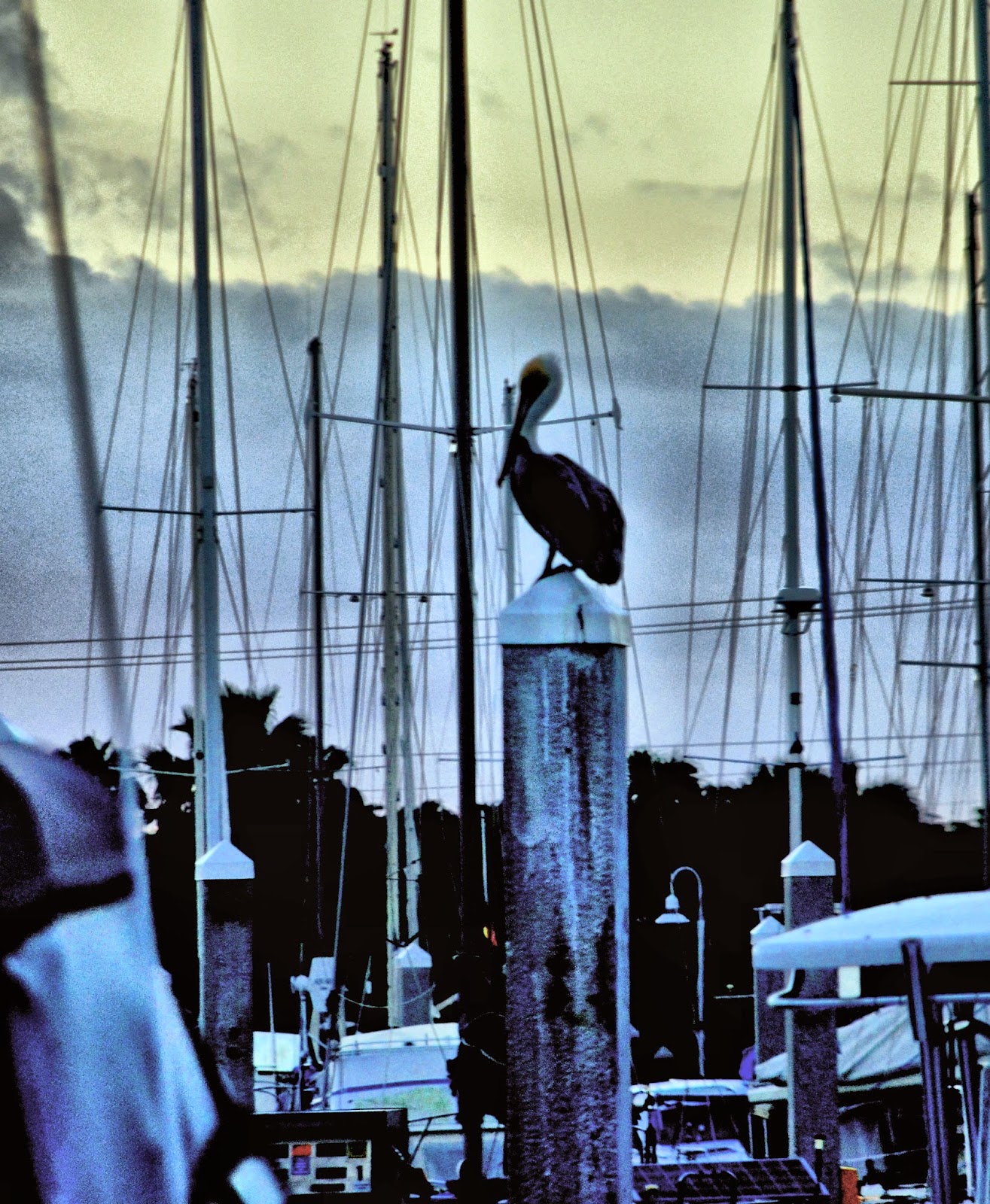
By the Dawn's Early Light

     This time change has meant that it stays darker longer into the morning.  Instead of seeing sun-up, it is just dawn when I head down the dock toward the office.   It give a different perspective on the day, birds still perched on the pilings and no real strong definition  as you glance around you.  I still love my early morning strolls, waiting for sun rise.  ;o)

Saturday, March 22, 2014

Flor de Cana: "Flower of Cane"

    The translation from Nicaraguan Spanish to English doesn't loose a thing, the Flor de Cana line of rums truly are the "Flower of Cane".    Making its first appearances is 1890, Flor de Cana was produced at the San Antonio Sugar Mill in Chichigalpa, Nicaragua.   Founded by Francisco Alfredo Pellas and still being run by descendants of Francisco Alfredo Pellas.   Flor de Cana has grown to be the largest selling brand of rum in all of Central America.    

     For over a century now Flor de Cana has been producing some of the finest rum anywhere.  There was a time though during the turbulent revolutionary year that the Flor de Cana producers were afraid that the Sandinistas would confiscate their supply of aging rum, so many of the barrels were hidden outside of Nicaragua.   After the elections that ousted the Sandinistas and property rights restored, Flor de Cana brought all of their aging rum back into the country and currently have one of the largest reserves of aged rums anywhere.

     Flor de Cana has modernized all of their facilities over the years until today they have a blend of traditional craftsmanship and the most modern facilities from which to produce their rums.      After building the distillery, it was not until 1937 that Flor De Caña was introduced by Compania Licorera de Nicaragua, S.A. (CLNSA).    Grupo Pellas was founded in 1950.    It was the first company to distribute the rum, and in 1959 it was first exported to VenezuelaCosta Rica and other Central American countries.

     During 1963 and 1965 the Plantation in  Chichigalpa underwent a complete modernization updates.       8 years later a second distillery was constructed in Honduras.   The Plantation in Chichigalpa was completely modernized in 1996.


     This year there has been another modernization of the bottling for these venerable old rums.  The new bottles have a different shape and label, and if you are not looking for them you will not recognize them as being Flor de Cana.   New label or old, the same time proven quality of rum is still what you pour into your glass.  
 
     We proudly pour the entire line of Flor de Cana that is available here in Florida at the Rum Bar here in Key West every day.  Give them a try you won't be disappointed.  :o)


Friday, March 21, 2014

Carta Vieja, the Unknown Distillery for Panama Outsiders


     Carta Vieja Rums are one of the most popular in Panama, but outside of Panama, they are very scarce and virtually unknown.   They offer several expressions of their rums and they are very respectable and popular among the Panamanians.
 
    Carta Vieja rum is processed differently. It is blended and aged.  The Anejo Rum is aged for years in used bourbon casks Aging adds flavor and color. Samples are taken throughout the process and when it is ready it goes off to bottling.   Carta Vieja offers 4 expressions, Claro, Extra Claro, Anejo, and Golden Cask 18 Year Old Solera.   All are very nice rums that sell very well in Panama, but are just becoming known here in America.
     An innovative way of aging rum that is most often employed by rum producers in Spanish speaking countries is called the Solera method of aging. Solera was once described by a rum expert as “Spanish for cheating”, but in fact is just a way of taking the raw edges off aged rum much quicker than the traditional one barrel methods of aging and gives the master blender much more control over the final product.
     Solera is a process for aging liquids such as wine, Sherry, Madeira, vinegar, brandy and of course rum. It is a method of fractional blending in such a way that the finished product is a mixture of ages, with the average age gradually increasing as the process continues over many years.
 
     Rum produced from a solera system should not have a formal age statement as it is a blend of rum from many vintages, but for marketing purposes the label will often display some sort of age.
     The only drawback from this system of aging is the initial investment in barrels, rum and warehouse space.
     The Solera system consists of a stock of rum in oak barrels, split into graduated units each of different maturation ages and each of equal volume. The final stage of finished rum is called the Solera. The supporting steps or scales are called criaderas. Rum for bottling and blending is drawn from the Solera, which is replaced by rum from the immediately supporting criadera of rum of the same style, but a little younger and less complex. From there, replacements proceed in succession down the scales of the system until the youngest criadera is refreshed with carefully selected young rum. The number of criaderas used before the solera varies from distillery to distillery. Many distillers will finish their rum in barrels previously used for sherry or port, adding even more flavour to the finished product.
     When rum from the oldest barrels of any one Solera is withdrawn for bottling, usually between 10 to 15% of the rum in the barrel, the same amount of rum is removed from an equivalent number of barrels of the first cridera or nursery. The rum is then blended and added in equal proportions to the space left in the barrels of the Solera. During the following months or years the slightly younger rum will take on the characteristics of the majority of the older rum in the barrel. All the rum in the barrel becomes exactly the same as the rum which was taken out months previously. 
 
     There are many rum companies throughout Central and South America are utilizing the Solera aging and blending system.   The system general produces a very nice resultant product.   ;o) 


Thursday, March 20, 2014

New High Tech Fake ID's, What Next to Trip up The Sellers of Alcohol?

     As though we don't already have enough pressure on us as bartenders to spot the under age people's fake ID's out there, but now they can fool the scanners the police are carrying.   Tell me, how are bartenders with only their eyes expected to make a decision as to what is real and what is fake.  This is becoming a serious problem, and one that can cost a bartender a lot of money if they get scammed by some of these new generation high tech fakes.   Below is a story that was on NBC 4 News that did some investigation into them and they found some very interesting things.

trying to buy cocktails.  Today there are


Some New Fake IDs Pass as Legitimate Licenses 

Source: NBC 4 News

By Scott MacFarlane

March 13, 2014

     A new generation of fake driver's licenses has infiltrated the Washington, D.C. region, many of them sophisticated enough to fool law enforcement and scanning devices, according to a review by the News4 I-Team. 

     Montgomery County Department of Liquor Control officials reported an influx of thousands of phony licenses in recent months, including a series of fakes that successfully tricked the driver's license readers utilized by county police officers during traffic stops. 

     An overwhelming number of the licenses were confiscated from teenagers, who'd used the licenses to purchase alcohol at restaurants or retail stores. 

     "They look like the type of identification you'd go to the motor vehicle department and purchase," Montgomery County Police Sgt. Mark White said. "Some people are trusting these [licenses] so much, they're actually passing them as legitimate driver's licenses to police." 

     Law enforcement officials suspect the latest wave of IDs was generated in China. The driver's licenses are manufactured there, officials said, then sold online to American teenagers. 

     Police said some of the sites, including vendors which were recently scrutinized by Congress, sell licenses for approximately $150. 

     Customers send credit card information or cash overseas to the site operators and later receive the phony identification in the mail. 

     Lee Williams, an investigator for Montgomery County, said the ID manufacturers have meticulous attention to detail, and include some of the microscopic details featured in legitimate state driver's licenses, including watermarks and fine print.


     First they were stealing our identity, now they have ID's that can fool the scanners and the police.  The system does need tom updating.  ;o)
 

Wednesday, March 19, 2014

A Brief History of "Kill Devil"

     Today it is known as Rum, but back in the days of the pirates and the sailors of the 1700's, it was called "Kill Devil".  Kill Devil or rum was a commodity and would be traded for salted fish, pork, beef, timber and livestock.   Very much  a part of the "Triangular Trade" between the colonies, Africa and Barbados during the era.  

    During this period, distilleries were found at nearly every sugar plantation in the Caribbean.  Kill Devil was readily available and could be found aboard nearly every vessel sailing on the ocean.  Barbados rum seems to be the first to be called "kill devil", but the source of the name is really obscure.   Most rums originated in the West Indies, Barbados in the middle 1600's , where they were called "kill devil" or "rumbullion".  By 1667, they were simply called "rum",

      American Colonists would buy slaves from Africa, and trade them for Molasses to make rum in New England, then trade the rum for more slaves.  The "Triangular Trade" flourished for more that two centuries, but came to an end in the 1880's.   Kill Devil was a valuable commodity and would be protected at all cost.

   Off of the Coast of North Carolina where the cold waters of the Labrador Current met the warm waters of the Gulf Stream, there are hazards of severe weather, strong currents and navigational hazards that have caused the loss of many ships over the years.  Known as the "graveyard of the Atlantic", there have been thousands of ships documented as having sunken in the area around "Diamond Shoals".   Pirates, Buccaneers and other scallywags were known to sail the waters off of Nag's Head and plunder the bounties from ships in distress around this area.  Pirates would put lights on horses and walk the beach with them luring ships to close to the shoals, where they would run aground and meet up with the marauders that would steal the cargo.  It was this practice that was the basis for the name of the town of Nag's Head.  Much of the rum taken from the ships was taken into the sand dunes and hidden until they could later retrieve it for sale or their own consumption.  These rums were reportedly "strong enough to "kill the devil"  hidden in the dunes of Dare County which was the reason that the area was renamed "Kill Devil Hills".   This is the same area that the Wright Brothers flew the first powered flight as well.


   Kill Devil, or rum as we call it today has a very long and glorious history, between the Maritime History and on the land, it is a very refined spirit today compared to the unaged rugged spirit of the days when it was known as  "Kill Devil".