Friday, December 16, 2016

Sugars in Rum that Get There from the Aging Barrels

Former Bourbon Barrels Filled With Rum
     There are small amounts of sugar in all rum. Most aged rums will have some sugars dissolved from the oak cask and often some from optional Caramel coloring.  Total amount of sugars are quite low, usually well below 1 gram/liter, but in certain cases it is quite possible to reach a few more grams per liter.   The sweet aromas of rum matured in used bourbon or new oak casks mostly come from sweet aromatic vanillin and fruity esters, not from the sugars.  However, sugars can have a significant role in the case of casks previously used for sweet wine or a sweetened spirit.

Barrels Repaired in Cooperage
     Another source of sugars in rum is wood. Oak is composed of three main macromolecules; cellulose, Hemicellulose and glucose.   Cellulose breaks down very slowly in alcohol-water solution extracting very small amounts of glucose to the rum.  Most sugars extracted from the cask come from hemicellulose, most of which are 5 carbon sugars.  


Large Aging Warehouse in Trinidad
     Probably the most important factor considering the amount of sugars in rum is the previous content of the cask. The most common type of cask is an ex-bourbon cask.  These will impart minimal amounts of sugars, often well under 50 mg/l/year and overall well below 1 gram/liter even during a long maturation.  The charred American oak cask used for bourbon is quite low on sugars to start with and the bourbon will extract a major part of the available sugars.  
      Rum can, and often does, contain added sugar or other sweeteners.  Most sweetened rums are sugared at the bottling phase, but sometimes sugar or molasses, cane juice, fruit etc has been added already into the cask and some of that sugar is bound to get into a cask that was used previously for rum.  Up to 40 grams/liter sugar contents have been reported in rum and up to 100 g/l in spiced and flavored  rums, but when the sugar added directly to cask the finished product is usually in the range of 5-20 grams/liter. 
Oloroso Casks Filled with Rum
   Significant amounts of sugar can be extracted from a sweet wine cask.   Sherry is by far the most used ex-wine cask in the rum industry.   Most sherries, such as fino, manzanilla, amontillado, palo cortado and most olorosos, are dry wines in the range of 0-5 grams/liter of sugars and add very little sugar to the cask.  The sweetness perceived in the olorosos often comes from high amounts of glycerol, not as much from sugars.  A notable exception is Pedro Ximenez wine, which nowadays is produced almost exclusively in Montilla-Moriles, a Spanish Denominación de Origen.  It is a sweet wine produced from late harvested dried PX grapes and it typically contains by law over 212 grams/liter of sugars. It is quite sweet even compared to other sweet wines, such as port that has 100-150 grams/liter, Sauternes at 100-200 grams/liter or a Tokaji that has 60-500 grams/liter.
    What does this all mean in the finished product?   It basically that sweetness in you rum may not be coming from added sugars.  By aging in final finishing in casks that were used for finishing sweet spirits and wines can impart their sweetness to the rum as it is being aged.  This is a process that takes time in the barrel, but it does give you not only a sweetness, but picks up some of the previous fill in  the barrel.  I love rums that have been finished in wine casks, they add a really nice finish to the final product.
There is a lot more information you can read on the subject at http://whiskyscience.blogspot.dk/2016/12/sugars-in-whisky.html?m=1


Thursday, December 15, 2016

2016 Key West Lighted Boat Parade

     After a delay because of high winds last week last night Key West had its annual Light Boat Parade in the Historic Seaport.  This is an event that draws great crowds on the land a huge group of boats participating and watching the boats as they parade past the judging stands.

     Every year there are so many beautiful holiday decorated boats to show all of them, but it makes for a fun night hanging out on the dockside and watch.   The other option for watching the parade is aboard one of evening party boats that are moored along the route and enjoying the parade while enjoying adult beverages.


     There were __ boats entered in the parade and
the color and the imagination of the builders is always spectacular.  There is everything from basic outline lighting of the boat and masts to complete animated scenes all in lights.  This is always a wonderful evening along or on the water.


Wednesday, December 14, 2016

Connecting Key West to the Mainland Part 3

Florida City, The beginning of the Overseas Highway
     The outbreak of World War II signaled the importance of Key West militarily to the U.S. Navy.   The existing Overseas Highway had many wooden bridges and sharp turns make it difficult for trucks carrying military equipment to reach Key West.   The Navy presence in Key West required stronger bridges to support its operations and security patrols.   Authorities at that point chose to utilize the entire route of the previous Florida East Coast railroad right of way, shortening the road by about 14 miles.  

The Stretch Connecting Florida City with Key Largo
     In the Upper Keys, a used drawbridge was installed at Jewfish Creek and the rail bed converted into a new highway from Key Largo to Florida City, bypassing Card Sound.  The Navy paved and upgraded the bridges to handle the very heavy loads of vehicles supplying parts and supplies to the Key West Base.  The Lower Keys faced similar problems and from Sugarloaf Key along the coastline to Stock Island was bypassed for the same reasons as the other areas, the new highway would run for the most part along the original railroad route.   Some of the remains of this route are still visible. This new route did however pass through the Boca Chica Naval Base, these were eventually rerouted to the outer perimeters of the base.  By creating the two bypasses, travel along the Overseas Highway was shortened by 17 miles, but at a cost of $5 million, authorized in February 1942.  

        Travel reasons were not the only considerations, the railroad bed through the Everglades was almost a direct route to the mainland, and a fresh water pipeline along with power and light transmission lines were built alongside Overseas Highway.   

 
The New and the Old Bahia Honda Bridge
     The official Overseas Highway dedication for this third major modification was given in July 2, 1944.  "I dedicate this road to the greatness of the Keys," said Governor Spessard L. Holland as he and his wife cut the ribbon atop the Bahia Honda Bridge. America had a road that allowed trucks, busses and autos to drive from Fort Kent, Maine to Key West along U.S. 1. This was a much larger celebration than the 1938 highway opening. 

      The railroad maintenance village on Pigeon Key served as headquarters for the Toll and Bridge Commission.   All construction, maintenance and operations were directed from this small island. Tolls were one dollar for the vehicle and driver, plus 25 cents for each passenger.   A increased pressure to drop the tolls resulted in the road tolls being lifted completely on April 15, 1954.  


The New and the Old Seven Mile Bridge
      1944 to 1978 was mostly a period of maintenance period except for a few significant changes in the Upper Keys.  The road was widened to four lanes on the Island of Key Largo, Tavernier in 1966, then to Rock Harbor to Lake Surprise in 1971 - 1972 and finally the Tavernier to Rock Harbor section was completed.  In addition there was $1.1 million spent to repair the Long Key Bridge in 1966.       In fact, all the bridges were deteriorating from relatively heavy use in an extremely harsh salt-water environment.   The beginning of the end was signaled when chunks of concrete began falling off of the 1938 built Bahia Honda Bridge overhead concrete slab.   In 1968, it was announced that two two-lane concrete spans would replace the old elevated railroad bridge at a cost of $7.9 million in July 1969.   Dedication ceremonies were held in August of 1972 when a 1901 Oldsmobile replica was the first car to pass over the new bridge which lies alongside the original double decked bridge.   One by one, most of the old rail bridge crossings have been replaced.


Key West at the End of the Road
     Today the road is being maintained with a few up grades here and there, but for the most part it is how it is going to be for quite some time.   It is a road that took over a hundred years to come about and one of the engineering wonders of the world, but more important it provides the keys with a reliable means of coming and going to the mainland.


Tuesday, December 13, 2016

Connecting Key West to the Florida Mainland Part 2

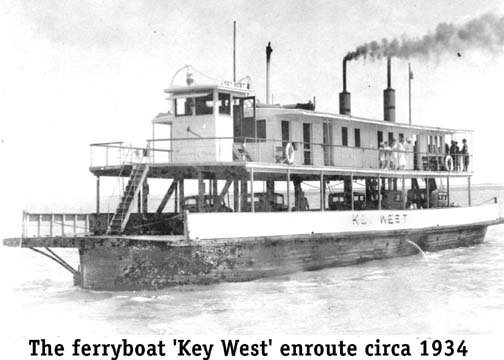
Ferry "Key West"
      The ferry service was not adequate, it had a very limited capacity, slow, unreliable, inconvenient and relatively expensive for the service it provided.  The ferries would often run aground, or be delayed due to low tides.  One ferry captain commented that there was not quite enough water for swimming and too much for farming.   Key West was not satisfied, so plans were being made to bridge the water gaps, in order to eliminate the ferries.   Army engineers estimated that it would cost another $7.5 million, but money could not be attained for the project.
     Monroe County was already in debt to the hilt, so the Overseas Highway Bridge Corporation for a toll road was formed in 1932.  Plans to the Reconstruction Finance Corporation to borrow $10.7 million to be amortized over 19 years, at which time the highway would be deeded to Monroe County.  The United States was in the midst of a depression, times were hard and money scarce.  October 12, 1932 the Reconstruction Finance Corporation forwarded its request to President Franklin Roosevelt and Congress, had placed $3.3 billion in the hands of the federal Board of Public Works. On July 4, 1934, the government created the Federal Emergency Relief Administration (FERA). Both Key West and Monroe County had declared bankruptcy at this point and FERA was sent in to bail them out.  Some of the “Bonus Army” veterans were sent to the Keys to build a highway from Lower Matecumbe Key to Grassy Key. The engineering and supervision were under the State Road Department and the veterans had their own supervisors making the coordination between the two groups problem some.  There were three FERA work camps were built at Snake Creek on Windley Key, at the upper end of  Lower Matecumbe Key and at the lower end of Lower Matecumbe Key.   By 1935, about 700 veterans were at work. There hadn’t been this much dredging, digging and concrete operations seen in the Keys. 
Aftermath of the Hurricane of 1935
     Labor Day, September 2, 1935, train crews were called to form a train to evacuate the veterans in the Keys from the approaching hurricane.   About an hour later, locomotive number 447 pulled a train out of Miami in route to Lower Matecumbe.   The train was too late. At about 8:24 that evening the clocks and much of life stopped in the Islamorada area.  Suddenly, the wind and a 17-foot storm surge of water turned the train cars over. Locomotive number four-forty-seven had a mission impossible.   Four-hundred-and-twenty-plus lost their lives that night. Over one-half were veterans and their families.  One ferry boat was lost.  All of the large concrete railroad bridges stood tall and straight. Many miles of the rock-made causeways and rail beds were washed out. Only a eight of the concrete highway bridge piers built by the WW-1 vets remained as evidence of the veterans' work.  

Laying the Road Bed over the Rail Bridge
     The debate to rebuild the railroad or build a complete highway began.  After the Hurricane, transportation in the Florida Keys was by plane and ship.  Pan American Airways flew to Key West. Using the remaining car ferries the City of Key West and Florida Keys, a temporary landing for limited automobile travel was quickly planned by the WPA to the lower end of Upper Matecumbe Key.  Two additional steel Mississippi River automobile ferries, were brought on line and the Lower Matecumbe Key ferry landing was restored after washed out fill was replaced.

     The Florida East Coast Railway was out of business, it was bankrupt just like Monroe County.  Monroe County's whose population, of which resided in Key West, needed to have either the railroad or the highway in order for the county to survive.   The highway in the Upper Keys was not seriously damaged by the hurricane, so the emphasis had to be put on the completion of the highway to Key West.  The Florida East Coast right-of-way from Florida City to Key West was available for $640,000 plus some tax debts being forgiven.  The Public Works Administration approved a loan to the Overseas Road and Toll Bridge District for $3,527,429.   The District in turn issued revenue bonds to be repaid with road tolls. The grand total was now about $8 million, roughly one-seventh what it cost Flagler to build the railroad, and roughly equal to the Army Corps of Engineers estimate just to bridge the water gaps.   Bridges for the highway had to be much wider than the width of a railroad track, work was contracted out and the repurposing of the railroad bridges to highway bridges got under way in May of 1937.  Steel beams were laid across the more conventional bridges and a layer of reinforced concrete encased the beams. Each bridge was given a nine-inch high and a twenty-inch wide curb. The road itself was twenty feet, curb to curb. All of this was done without loss of life.   The big challenge came when they reached Bahia Honda Key, this was a narrow trestle style bridge across the deepest section of the waters. The top of the camelback trestle rose a dazzling sixty-five feet in the air. The final solution was to build a concrete road slab on top of the trusses and start the rise and decent before reaching the high point of the bridge for safe auto travel. The Bahia Honda Bridge was the finally bypassed when a new four-lane bridge was constructed in 1972. 

President Roosevelt Arrives in Key West
     The highway was opened for traffic on March 29, 1938.  The nation was first made aware of the Overseas Highway on February 18, 1939 when President Franklin Roosevelt passed through the Upper Keys in route to Key West.  Key West mayor, Willard Albury, met the president at the west end of the Bahia Honda bridge on West Summerland Key where he accompanied the president to Key West and a tour of the mothballed Key West Naval Facilities.   It was a long time coming, but it was finally finished and there was a road from Key West to the Mainland.  

Monday, December 12, 2016

Connecting Key West to the Florida Mainland Part 1

Train on the seven mile railroad bridge
   The possibility that a highway from Key West to the mainland was first uttered in a political address by George W. Allen in 1895. The first real step that would indicate the coming of a land transportation system in the Keys was the railroad.   Post offices came along with the railroad providing daily deliveries of people and goods. The Overseas Highway really came about because of the 1935 hurricane that destroyed Flagler's Florida East Coast Railway.   This is basically true, but the highway actually started happening before that.   The building of the Overseas Highway really began in 1917.  Monroe County floated a $100,000 bond issue to build roads, and trails, on Key Largo, Big Pine Key and the Cow Key Channel Bridge between Key West and Stock Island.

Florida Year - Round Club (Angler's Club) Key Largo 1930's
    What really sparked the need for the Overseas Highway was the rapid growth of the real estate market. Monroe County was only accessible by the railroad and the Miami Motor Club wanted to give its winter tourists a suburban fishing ground. The real estate interests wanted vehicular access to the thousands of undeveloped acres in the Upper Keys.  Dade and Monroe County commissioners met jointly and decided to connect Key Largo with the mainland.  They wanted to follow the railroad route, but the Miami’s interests wanted a route that would help the fishing, that was the Card Sound route, which finally one out.

   Monroe County residents voted a $300,000 bond issued in 1922 to construct a road from the Key Largo Anglers Club, which began at the turn of the twentieth century as a small fishing camp and trading post on the Bay side of Card Sound, that became part of the “Florida Year Round Club in the early 1930's. to the Key Largo Train Depot.

Ferry Boat "Key West" around 1934
      Dade County completed the 11 miles of road from Florida City to Little Card Point, between Card and Barnes Sound.  Monroe County built the drawbridge and connected the Dade County road to the existing North Key Largo road.  The roadway and bridge were severely damaged in the 1926 hurricane, a decision was made to raise the bridge height from five to nine feet as a result of the damage. Until the completion, in March of 1927 an auto ferry towed by a powerboat transported cars from Florida City to the east end of the Card Sound bridge.   The road was also made serviceable as far as Islamorada during that same time period.  J. Otto Kirchheiner, chairman of the Monroe County commissioners, was the first to drive a car using a combination of roads and ferries from Key West to the mainland on July 18, 1927.   .    Key West had built a road as far as No Name Key and the construction of a ferryboat pier began at Lower Matecumbe and No Name Key connecting the two ends of the keys.    January 16, 1928, three ferryboats at a cost of $850,000 were put into operation between Lower Matecumbe Key and No Name Key. One ferry would go east and one ferry would be returning west.   The third was kept in reserve or in maintenance. However, one ferry burned eight months later. This was a 41-mile ferry trip.  Each ferry could take 20 cars and the trip took about four hours. The toll was $3.50 for vehicles under 14 feet up to $6.50 for vehicles over 16 feet, driver included. Passengers were charged $1.00 each.  Officially for the public the Overseas Highway opened January 25, 1928. 


Sunday, December 11, 2016

The Special Problem of Converting the Bahia Honda Trestle

The Days of the Train
     When the time came o convert the Bahia Honda trestle to a highway bridge there were several problems that had to be overcome.  The structure of the bridge meant that it could not be taken apart and just lay the reinforced concrete beams on the old road way.  The structural integrity of the bridge would be lost.  Therefore the roadway had to be laid down on top of the structure.  There was a problem there as well.  The hump in the center rose to fast to just follow the shape of the bridge, so it had to be gradually ramping up to the peak and back down.

Looking at the Deteriorating Roadway Today.


Saturday, December 10, 2016

Protect Yourself from Law Suits from Your Holiday Party This Year

     Holiday gatherings are supposed to be a time to build the morale for those who don’t get to spend time on a social basis.  Their purpose is to encourage people who don't normally socialize with colleagues to enjoy themselves and talk about things other than work.   These parties are usually a lot of fun unless someone manages to ruin it by getting out of hand by too much of a good thing.  This is where the party can get out of hand and wind you up at the wrong end of a nasty suit.   Here are some ways to help you keep out of trouble without having to scrap your holiday party.  These apply whether you are having a company party or just a gathering of friends at your house. 

You Don't Need This Guy at the Party
     First and most important most important is to have a good handle on the amount of booze available to those attending.  Diminished capacity of a party goer from overdrinking is not a defense to claims of harassment or assault and that hosts could ultimately be held responsible because they created the environment for that conduct to take place.  It is after all your place and your responsibility to control the behavior of the people that you have invited.    You shouldn't have an open bar with unlimited drinks at any of your holiday parties.  Limit the drink menu and to make sure to have one person to pour and serve the booze, preferably someone that is not a guest of the party.

Give up Your Keys if You are Drinking
     Getting people back home after the party is the next consideration.  In to many cases, people will leave the party and drive home after imbibing way too much.    Have cars and taxis available to make sure that those who have had too much to drink get home safely.

Can't Wait to see This Party on You Tube
     In today's world of social media, smartphones are always present and people will always be taking pictures and videos of moments they think are funny, particularly if somebody starts acting up at the party.  Today these holiday parties are no longer a private party, but rather an open party.  Party goers should be reminded of basic ground rules before posting or sharing any scenes from a holiday party.   The old days of what goes on at the party stays at the party are long gone and there are expectations of privacy when you are hosting a holiday party.

     It is always important to remember when you get a group of people together, not everyone has the same values and opinions.  It's not appropriate in the general society and not appropriate at a holiday party to belittle or treat other guests with disrespect.   It is never easy to keep everything under complete control at a holiday party, but paying attention to what is happening at the party that you are hosting will limit the chances of a problem that could wind up with you in an ugly law suit at the end of the night.

     Here is to a wonderful season of holiday parties and the safety and happy conclusion to what are supposed to be happy events.


Friday, December 9, 2016

Organic Rum? What's the Difference?

Organic Rum
      True, if you're changing your eating and drinking habits to reduce your exposure to toxic chemicals, switching to organic rum isn’t likely to do you much good.   The chemicals you're trying to avoid are entirely taken out of the picture during the processes of fermentation and distillation.   There has to be another gain to the consumer to make it worth going for.
      Puerto Angel Rum which came to the USA in the summer of 2015 is one of my favorite rums, but it is because of how it is made more than the use of organic sugarcane.   The cane fields are just minutes from the distillery, it only takes a few hours for the cane to go from the cane cutting, to the crushing, then to the fermentation tanks.  Puerto Angel Organic Rum is USDA Organic rum, distilled from freshly squeezed cane juice at the Krassel family-owned distillery which does produce some of the finest artisanal spirits.  The family opened the distillery in 1938, and established their own organic sugarcane plantation in the high levels of the Oaxaca Mountains, Mexico. 
Organic Sugarcane
     But thinking about the bigger picture, and looking at secondary benefits, organic rum made from organic sugar cane can reduce the overall spraying of pesticides and the resultant contamination of soil and groundwater.   Drinking a rum distilled from organic sugar cane can have an impact beyond the drinker's immediate environment, and also provides a financial incentive for growers to use more earth friendly farming practices.  Florida’s sugarcane fields are a huge source of pollution of the waterways and the everglades, that could help all of us if they were to use more earth friendly farming practices.   "There is a historic load of phosphorus already in Lake Okeechobee that came from the sugar farms."  There is a current load, though it is not a major percentage that is coming from the sugar farms.  The key is to keep reducing this load.

     I feel that the organic rum is a good thing because of what it does to improve the quality of the earth more than the quality of the spirit.  Distilling removes the impurities from the spirits, making the organic card a moot one as far as the finished product goes.

Thursday, December 8, 2016

Where do I get the Super-Premium and the Ultra-Premium Rums?

     Momentum finally building behind rum, the last spirits category to fully climb up the value ladder.  Perhaps it’s finally rum’s time to shine.   Key to this was shifting the consumer conversation to premium offerings and placing an emphasis on the premium and ultra-premium expressions.  One of the weaknesses of rum is that the super-premium and ultra-premium categories are relatively underdeveloped, compared to those of whisky and cognac.
     The other problem for the rum customer is that those looking for rare and top quality rums are being forced elsewhere.  The rum consumers look to online resources, rum clubs and friends traveling abroad when they are seeking high-end rums.   They are simply aren’t available in most liquor stores,  even if they are, then they are only sporadic on the shelves and not enough to get the connoisseurs excited enough to keep visiting the stores on the off chance of finding something to suit their taste.
     It’s been several years where the rum category has been working to develop and fill the gap between the low end production rums and that of the super-premium and ultra-premium expressions.   In many cases, the retail portion of this equation has no idea that there are really expressions of this caliber from the category.   Rum has to seriously attack this lack of knowledge relating to these expressions both at the customer level, but at the wholesale and retail level as well.  This after all is the only sector of the category that is showing some sales growth, while the rest has been losing ground over the past couple of years.

    Great rums do no good if the customers can’t get their hands on them.  It seems to me that the industry needs to put as much effort into educating the public and the market place of the availability of these wonderful expressions. 

Wednesday, December 7, 2016

Where Does Rum’s Color Come From?

     Have you ever wondered what gives all the different types of Rum their colors?  Rum is one of the few spirits that comes in a range of colors and flavors, from light and fruity to hot and spicy to deeply dark and mellow.  If you are unsure which rum is for you, a good start is often to be found simply by looking at its color, different colors of rums can help you to find the one that suits your palate.
There are white rums, golden rums, dark rums and black rums. There are also three main ways in which a rum is made, which gives a clue as to its coloring.   Traditional rums are made from molasses, cane syrup or fresh sugar cane juice.  Traditionally, each color of the rum is and indicator of the age of the rum.  The type of sugar used to make rum is not as important as how it is made and rested.
     White rum is in general, the youngest type of rum.   It is unaged or maybe a year or two spent in barrels. It is then filtered to remove any color that it got in the barrels and bottled.   Most white rums have a mild to neutral flavor, and are best used in cocktails.  White rums generally are not for sipping, they tend to be a bit harsh and have little mouth feel.   There is a taste for unfiltered ‘hot’ rum that is just a step or two above moonshine for flavor. This type of white rum is very young , most has a higher percentage of alcohol and a burning effect in the mouth.
     If rum is allowed to age undisturbed for a few years in a good oak barrel, it will begin mellow and develop a light golden color from the wood.  A good palate will pick upon tastes of spices, citrus and or wood.   Be careful in any of the golden rums, because there are some of the producers that will add brewer’s caramel to unaged rum to give you the illusion of being in a barrel.
     Dark rum is in general aged for more than two or three years in oak barrels, picking up a copper or mahogany color. These rums will provide a rich flavor profile that is very sippable and satisfying compared to the golden rums.  While technically a dark rum, black rums have a unique flavor profile due to their unique aging process.. For this reason they are favorites in many dishes and mixed drinks.   These rums are treated differently than many light rums. The black run is aged in heavily charred whiskey barrels or other oak barrels that are heavily charred before use. This treatment releases much of the wood’s flavor into the developing rum.

     This is where the colors and flavors come from in traditional rums, but be aware that many rum producers will add brewer’s caramel to enhance the colors after they are reduced from the high percentage of alcohol of the rums in the barrels as they are aged down to the traditional 40% that most spirits are bottled at.  This is a common practice that gives the brand a color consistency and back matching the color that came from the barrel in the first place.  There are others that will take rums that have spent less time in the barrels who add the caramel and other additives to give you the impression that they spent more time in the barrels than they actually had.

Tuesday, December 6, 2016

Audit of the House of Angostura Rum Practices

     The integrity of Angostura's rum is under audit.  Angostura rum company has been buying bulk rum from Cuba and South America and simply repackaging it, without substantial chan­ges, and selling it to export markets.  This action is in breach of the European Union's rules of origin with regard to rum blending integrity, and raising questions about the claims for its rum blends true age, according to board documents from Angostura.   Angostura, a publicly traded company on the Trinidad and Tobago Stock Exchange and could be fined for its breaches, board minutes have indicated.


Robert G. Wong
     Angostura chief executive Robert Wong has been on administrative leave for two months after the discovery by the board of directors.    Robert Wong told the media, “I won't comment just yet. I am not guilty of anything. It's unfortunate. I am not sure what the motivation is. I understand the present board wanted a changing of the guard and we had discussed it, but that action didn't go through.”   Angostura has informed the Securities and Exchange Commission (SEC) and appointed Genevieve Johan, executive manager of export and business development, acting chief executive. 


Angostura Aging Bodega

     The board of directors first became aware of this issue in August when it was asked to sign off on a $16.5 million purchase of heavy rum concentrate to meet its rum production quota for 2016 and early 2017.     Angostura's management could not guarantee the integrity of the products which had been exported over the past few years as it had not been sufficiently transformed during the distillation process.  The management also could not guarantee that it had not made false declarations in the export certificates of origins of exports using heavy rum concentrate  in its rum blends.


     The House of Angostura in a statement said, "The integrity of Angostura's international branded rums is not under audit," says Mrs. Genevieve Jodhan, CEO Acting of Angostura Holdings Ltd.  "All our international branded rum products are aged and meet international standards." 

Read More at http://www.trinidadexpress.com/20161203/news/audit-into-angostura-rum-ceo-sent-on-leave-company-using-foreign-bulk-rum-in-local-products-for-export


Monday, December 5, 2016

American Prohibition Repeal Day

American Prohibition
January 16, 1919 until December 5, 1933

 
    On December 5, 1933, the 21st Amendment was ratified, as announced in this proclamation from President Franklin D. Roosevelt. The 21st Amendment repealed the 18th Amendment of January 16, 1919, ending the increasingly unpopular nationwide prohibition of alcohol.

Where Did the Snaquiri Come From?

     The "Snaquiri"—or a tiny Daiquiri meant to be taken as a shot—has become a nationwide bartender handshake.      The original Snaquiri, however, wasn’t a shot. In fact, it wasn’t even a full-sized drink: It was two full-sized drinks, served side by side.  Today, they are a 2 oz. mini daiquiri served as a welcome or just to get the party started.   Karin Stanley of NYC’s Dutch Kills, is widely credited for both the concept and the name.    “We were talking about our favorite drinks, the daiquiri and started ordering them two at a time, one in a water tumbler and one in a coupe”.   We’d shoot the water tumbler and sip the coupe.” A few puns later, the Snaquiri was born.   

     As time passed, the Snaquiri was downsized to a 2 oz.  size for the average drinker, though it’s hard to say exactly when that happened. “It has definitely gone off on its own to be a Daiquiri shot,”   This is a great concept and it has spread like wildfire across the country.
     I love the idea of taking your favorite daiquiri and breaking it up into 2 oz. size shots and passing it around among a group of friends.  It is the kind of shot that a group can enjoy and not find themselves under the table in just a few minutes.   The daiquiri is a very versatile cocktail that can be tailored to the tastes of most any group.  Careful if you choose to use the “Hemingway Special” as your base daiquiri, because it is a truly butt kicking daiquiri to start with.
Here is an idea for a great starter daiquiri from which to make these fun “Snaquiri’s” based upon.  
Bahama Bob’s Basic Snaquiri
  • 2 oz. Premium White Rum
  • ½ oz. Luxardo Maraschino Liqueur
  • ½ oz. Galliano
  • ½ oz. Agave Nectar
  • Juice of ½ Lime


Place all ingredients into a shaker filled with ice and shake until chilled strain into shot glasses and enjoy.

Sunday, December 4, 2016

Beautiful Sky of Fall

Winter is nearing here in Key West.  The humidity has dropped significantly and the blue of the sky is unbelievable.   I love this time of year, because I can get out on the bicycle and enjoy my rides enjoying the unpredictable beauty of the clouds, sun and sky.   I'm hoping where you are is as beautiful.   Enjoy the late fall.

Saturday, December 3, 2016

Scotland Launches its First White Rum

     The team behind Edinburgh bar, Bramble has co-created Sea Wolf, the “first” white rum to be distilled in Scotland.   White rum Sea Wolf is first spirit from Boilermaker Drinks Company.   Mike Aikman and Jason Scott have joined forces with Gavin Ferguson, co-founder of Scottish independent wine merchants Vino Wines, to launch Boilermaker Drinks Company.   Their plans calls for the production of a full portfolio of Scottish distilled spirits.     The new white rum, Sea Wolf is being made in Angus at Ogilvy Spirits and the first launch by Boilermaker Drinks Company.
     Rum is a massive player in the British cocktail world, but there were very few British brands distilled in Great Britain, thus Sea Wolf was born.   “Unlike gin which we feel is reaching saturation point in the market, British rum is about to have its time in the spotlight and we aim to be at the forefront of this.”
     The fermentation of the spirit’s base ingredient, cane molasses, is done at low temperature for four weeks using both rum and Champagne yeasts, resulting in an “unusual” flavor profile.   Notes of unripe banana and sugar cane on the nose give way to tropical fruits on the palate, with a faint citrus and spice finish.
     “Scotland is not the ideal climate to be making rum in but we love a challenge so we set about developing a full-flavored rum good enough to work well straight and as a base for cocktails.”    A rum that has character, flavor, mouth feel and body can be difficult with an unaged spirit, but Boilermaker Drinks Company believes they have the right formula.
     The spirit takes its name from the Native American term for killer whales, which are found dotted around the Scottish coastline today.   Set to launch on 1 December 2016, Sea Wolf is bottled at 41% abv. Only 300 bottles will be made available before the end of the year.